An Interview with Alan Bahr

Alan Bahr is the publisher and founder of Gallant Knight Games. He’s a prolific and award-winning rpg designer and writer.
Mario | La Esquina del Rol: So, Alan Bahr, welcome to La Esquina del Rol! It's really exciting to chat with you. Before I talked to you through Bluesky, I became familiar with your work by reading and playing your games, and I'm a big fan. For those who might not know you yet, can you tell us a bit about yourself, and how you became a recognized figure in the TTRPG world?
Alan Bahr | Gallant Knight Games: Hey Mario! Thanks for having me. I really appreciate the kind words.
Truthfully, I'm not sure I'm a "recognized" figure, but I've been making TTRPGs for about ten years now. I started by doing Kickstarters and just kinda kept going. It's not a very exciting story!
I run Gallant Knight Games, where I produce all the games and design the majority of them. I also freelance around the industry for a variety of folks!
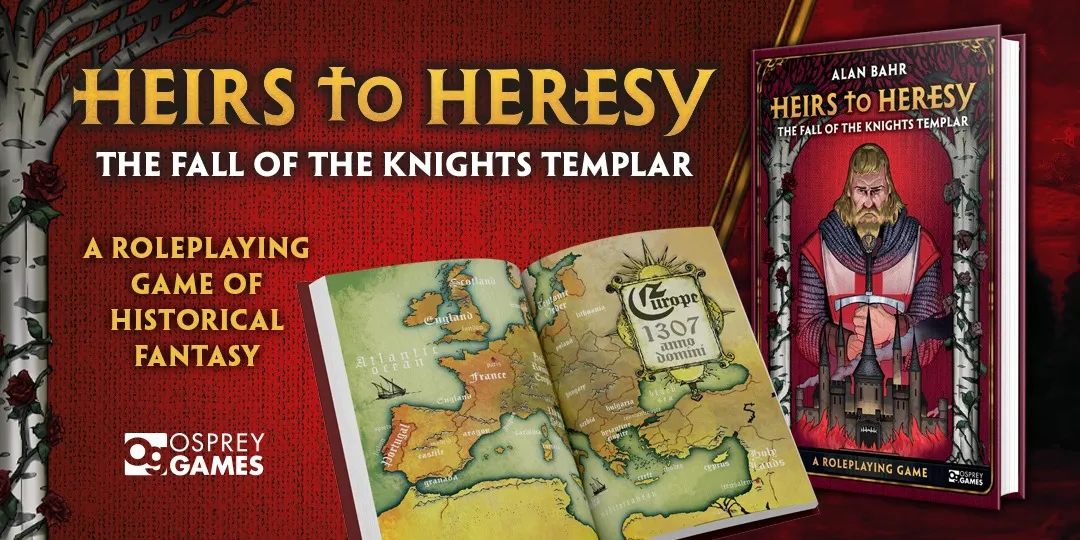
If you've heard of me, it's most likely for TinyD6 or some of my Osprey Games like Crescendo of Violence and Heirs to Heresy.
Mario: You do great things, my friend! Sometimes the books/zines don't let us see directly what they provoke at the tables where they are opened. But, at least in the Spanish-speaking community, your work is much appreciated.
One of the best campaigns I have played by post was with Tiny Dungeon, and it was amazing. I played with a Hippo Kin who had delusions of grandeur but was really useless. Hahaha! He was really cool! Someday I will tell you about his adventures.
But well, back to you. How did you get into this hobby?
Alan: Like many people (at least my age) I started with the 3.x era of D&D, playing with friends in middle school and at scout camps.
Mario: What really drew you into this hobby? How did it stand out from other interests you've had? In my interviews with fellow hobbyists, there's always something that makes us feel happy and secure in our pursuits. What is it that keeps you engaged and working within this hobby even now?
Alan: Oh that's a big set of questions!
Well, part of it was just the attitude of writing a story as a group. I loved reading fantasy novels, and D&D was a natural step from the D&D novels I was reading.
After that, I fell in love with how ttrpgs were a mix of story telling, community building, and imagination. I find the idea of how we tell stories interesting. Why do we do it? How to ttrpgs enable that? Why do some mechanics, rules, dice, stories, and themes make us respond in ways that others don't?
I often say "I'm an academic, making rpgs as a way to study and understand them." I don't come at it from the persepctive of art (though they are art!) I just don't approach from the concept of "art" and "artist", but instead, I come from a very academic approach to them. i want to put them into action to see what makes them tick. I talk about this a bit on my blog.
Mario: I share several ideas with you here. Like you, I view tabletop role-playing games from a more academic approach, perhaps influenced by my professional background and day job. I really liked your post because I see in it several reflections of my own thoughts, questions, and doubts. Also, I'm still searching for who I am.
These interviews, in their truest intent, aim to answer many questions I have, just like you, about the phenomenon of group storytelling, game design, and the development of this intersubjective experience. I've always said that I see tabletop role-playing games as a cultural product. However, as you might anticipate, this tireless pursuit has only generated even more questions.
I'd like to delve into the differences you find with your colleagues in the way you approach game design. In this context, how do you approach game design?
Alan: To me, when I sit down to design a game, I'm often trying to ask (and then answer) or explore a particular topic or genre. Usually, these themes are mechanical, as I am most interested in the tactile element of where games intersect with physical objects (or the explicit lack thereof). Games are a delivery system for experiences, and I'm interested in trying to unpack what that all means.
Mario: I would like to dig a little bit more into this. I would like, if you like, to exemplify this through Siege Perilous. How did you approach the design of this game?
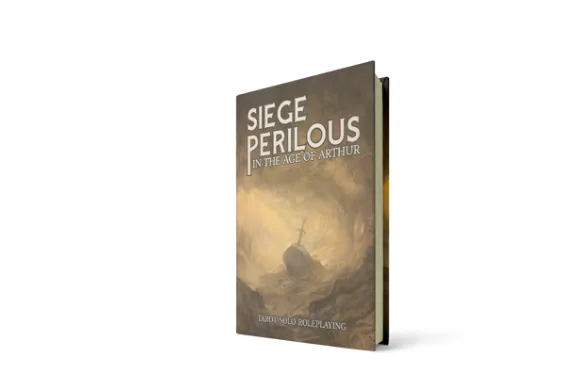
Alan: Sure! So with Siege Perilous, it came from a place of emotional melancholy. That was one reason that I was adamant it had to be a solo roleplaying game. Melancholy works best (in my opinion) when you can enforce a feeling of loneliness. The deliberate use of solo as a mode was key to that.
Secondly was the decision to use tarot cards. Tarot is a wonderful medium for inviting imagination while bounding it in a consistent "foundational" approach.
So the tactile use of card flipping forces a player to look at the table, to be there, to be present, to be immersed,w hile the solo play helps enforce the emotional resonance.
Those are just two examples. There's a lot more, but the whole game kinda is built on a scaffolding like that.
Mario: That's the best design argument I've ever heard myself for choosing design a solo RPG. Now It has become very clear to me what you were saying earlier about your differences in design approach from your colleagues. Very interesting.
Some designers have shared with me certain general design principles that serve as frameworks for their own game designs. Do you have any principles or frameworks that have influenced most of your work when you sit down to write and design?
Alan: I think my only real framework is to assess what the game needs and do that. Every game has different needs, different reasons for being. There are a thousand and one (and more) ways to make, play, experience, digest, and understand ttrpgs, and no one experience is the same. Why should hard and fast rules for designing them be the norm?
Every game has unique needs, so every game must be met on those unique grounds.
Mario: Of the games you have written and are currently working on, over these ten years in the industry, which game, whether it is directly yours or not, has posed the greatest challenge for you as a game designer and why?
Alan: I think most games are a challenge in different ways. If I get comfortable with a game (TinyD6), I have to work to make sure I don't get lazy or complacent. Comfort is a trap where you end up repetitive and dull. I've got one I'm working on now that's unannounced that's very ambitious, and it's posing hard but such is the work.
Mario: Some time ago I interviewed Alex from Blackoath entertainment. And he told me that you really liked his game Sacrifice RPG. I wonder what kind of games are the ones you like now and what elements do these games have that catch your attention to value them positively, and can you share with us some examples of games you have liked lately?
Alan: Alex is great! He's one of my dearest friends and I really love bouncing ideas and talking to him. Sacrifice was the rpg that opened up the idea of solo play for me, so it's been very influential over the last few years.
I admit to being a person who enjoys liking things, so I often try to find the good in something, even if its not perfect. Some of my favorite RPGs are King Arthur Pendragon (I prefer the 5.2 edition), Burning Wheel (and Torchbearer), A Town Called Malice (Monkeyfun Studios)
I like games that have macro-elements, game elements that are bigger than the character. Domain/kingdom/manor management, macro-games (like Blades in the Dark), where the setting evolves by a set of mechanics larger than the characters. Naturally, by extension a lot of my games have similar style mechanics.
Currently, I'm playing and enjoying the Cowboy Bebop RPG, a few playtest games for GKG/myself, Traveller, a long running superhero rpg (currently on a playtest system). I like a mix of genres, as well as themes. I play a lot of "traditional" style rpgs, as well as story games, indie games, and really anything I can get my hands on. I play about 5 weekly RPGs, and I tend to like most of them!
Mario: Alex is very talented and I admire his work as a solo game designer. But I'd like to dig into Sacrifice and the influence it had on you when designing solo RPGs. What interested you about this type of games, and what resonated with you?
Alan: Quite honestly, solo games never clicked for me. I just couldn't wrap my brain around them. I'd tried playing quite a few and always bounced off. Sacrifice looked cool (I dig Alex's "Iron & Incense" genre ideas and themes) and so I bought it. When I read it, it really made the idea of solo play click and become understandable for me, which was key to helping me realize how I can move forward with adding solo components to all my games that it's appropriate in.
So it was a combination of theme, as well as opening an understanding I was lacking that has pushed me to call it a huge influence.
It decoded the mysteries of solo ttrpgs and that worked wonders.
Mario: I have always thought that solo RPGs are not for everyone nor for playing everything. I am honestly an enthusiast of them. However, I am glad you gave it a chance and found in Alex the understanding of how to make them work.
I would like to return to your answer from my previous question. I am very interested in these macro-elements you mentioned in TTRPGs, that you enjoy playing and being a part of the game. Can you share with us your an example of these macro elements/set of mechanics of the game and explain what you like about them?
Alan: So, when it comes to macro-elements, I'm a big fan of specific implementations that gamify ideas that are larger than the characters. It has to be more than things like weather tables. I'm always looking for something like "kingdom management" (a la Birthright/et al), organization management, or similar setting/game based ideas that are things the characters interact with, but exist at a larger scale.
I'm a big fan of Pendragon's Manors, and how those impact your characters and families, and how your character becomes a reflection of their surroundings.
Mario: You've been in the industry for a decade now, Alan. A lot has happened since then and in one way or another this has affected for better or worse the way you make a living with GKG. We are a niche market and now we face a complicated scenario for the more indie publishers. Just these days you have published about Gallant+, an interesting move in my opinion, not only as a means of substance, as a publisher, but also as a liberation from the enshittification that is experienced on some platforms. What can you tell us about this decision and what we can expect from supporting you in this way?
Writing updates that tread the line between marketing, keeping folks informed, and not being a chore to read is a delightful tightrope.
Anyways, we closed our patreon to provide the same service through our webstore, with improve services.
shop.gallantknightgames.com/pages/gallant
— Gallant Knight Games (@gallantknightgames.com) January 25, 2025 at 4:56 PM
[image or embed]
Alan: Wow, that's a big question and it's gonna be a super long answer. First off, a decade? Geez, it feels both wildly longer and much shorter than that. For the last five years, I have been full time with GKG as my sole source of income (aside from freelancing and pick-up jobs). While my spouse still works (we need insurance), the portion I provide to the family is pretty much fully GKG/ttrpg industry work. That has certainly changed my perspective on things.
One of my biggest concerns is always "How can I make sure GKG is protected?" GKG is more than me. It's the time and effort we put into paying good rates for freelancers, paying early and on time, pricing our RPGs in an affordable and ethical manner, where we make money but we also make sure folks have access to the games. I take GKG very seriously, because to me, GKG is about leaving the RPG industry better (at least a small portion) than it was when I entered. As the world changes, as markets adjust, and as companies merge or sell, I always look at the risks to GKG.
A good example of this is Roll20 acquiring DTRPG. Now, let me preface this by saying I don't think anything "wrong" was done, but it's just a relevant example of how the industry can change quickly when big players make moves or changes.
When Roll20 acquired DTRPG, DTRPG changed. Previously (in a simple sense), DTRPG's focus was helping publishers sell games to customers. That was it. They had two audiences. The people who want to sell games, and the people who want to buy them. With the Roll20 acquisition, that focus changes. Now their customer base is: 1.) Publishers with games to sell. 2.) Customers who want to buy those games. 3.) Customers who want a digital space to play in (and will pay a monthly surcharge), and 4.) publishers who want a space to sell games for that digital space.
Roll20 probably makes more selling someone a monthly sub to their VTT than they do on my games. If I sell a game for $10, they get $3.50 of it. So they have to get that customer to buy three of my games to make up for one VTT monthly sub AND it's dependent on me having games folks want to buy. That likely means their priority (for them) is the VTT side (in terms of revenue and making customers pay attention).
Now, I'm oversimplifying a bit to make a point, but you can see how the sudden acquisition can alter the way the single largest digital platform (and frankly probably largest platform) for selling ttrpgs behaves and maybe in a way that isn't great for you (lots of my games aren't VTT suited due to the minimalist nature). That has an impact. And so when things like that happen, I take a look at how they impact GKG.
That kind of example is why GKG has recently launched tinyd6.games (our own webtools kit) and Gallant+. Gallant+ is basically just our patreon, but managed through our webstore. Patreon takes their cut (5%/10%/whatever depending on your plan), but you can't modify their UI. You are at their whims for improvement, tools, and more. With Gallant+, I can have more control. I can give better rewards, communicate easier or with a better plan, or apply automated discounts (doing rewards at cons for example). Our webstore is mostly our own thing! We control our product listings. We can control the visuals. Obviously we use a plan (in this case Shopify), so we have to cede some control, but even then, we can export the data and move to a new webstore and still own the domain and data, which means we lose much less when things go wrong or change and we have to adjust. But we have new tools (integrations with other platforms that direct back to our Shopify, etc), we can handle customer support to our standards.
I feel that GKG's community is best served when my decisions strengthen their abilities to be part of the community, and so far they've agreed and supported me. Gallant+ is a bit of a swing, because it changes where folks can find us. But in the end, it's a good choice (I think)!
Mario: It seems to me a decision in line with what is happening in our world today, taking control of what we do is a priority. Changes are part of life, adapt or disappear. I sincerely hope to continue to see you putting out great products and I appreciate your effort to pay well in the industry, I know that one of your latest crowdfunding is going very well, and I invite those who read us to be aware of this and other projects coming in 2025. G+ has a cost of ten dollars, it seems to me a great opportunity to support and follow the project.
Without committing yourself and in general, what other projects are coming this year for GkG, and where can our readers follow these and other GKG projects?
Alan: The best place to find updates on my GKG work is at gallantknightgames.com where you can sign up for our newsletter.
We're on various social medias as Gallant Knight Games!
As for upcomign projects, we have more TinyD6 books, the impending release of D6 System 2e, and several more exploratory rpgs coming!
...And that's all for today, until next time!
The Alan's next project.