An Interview with Goblin Archives

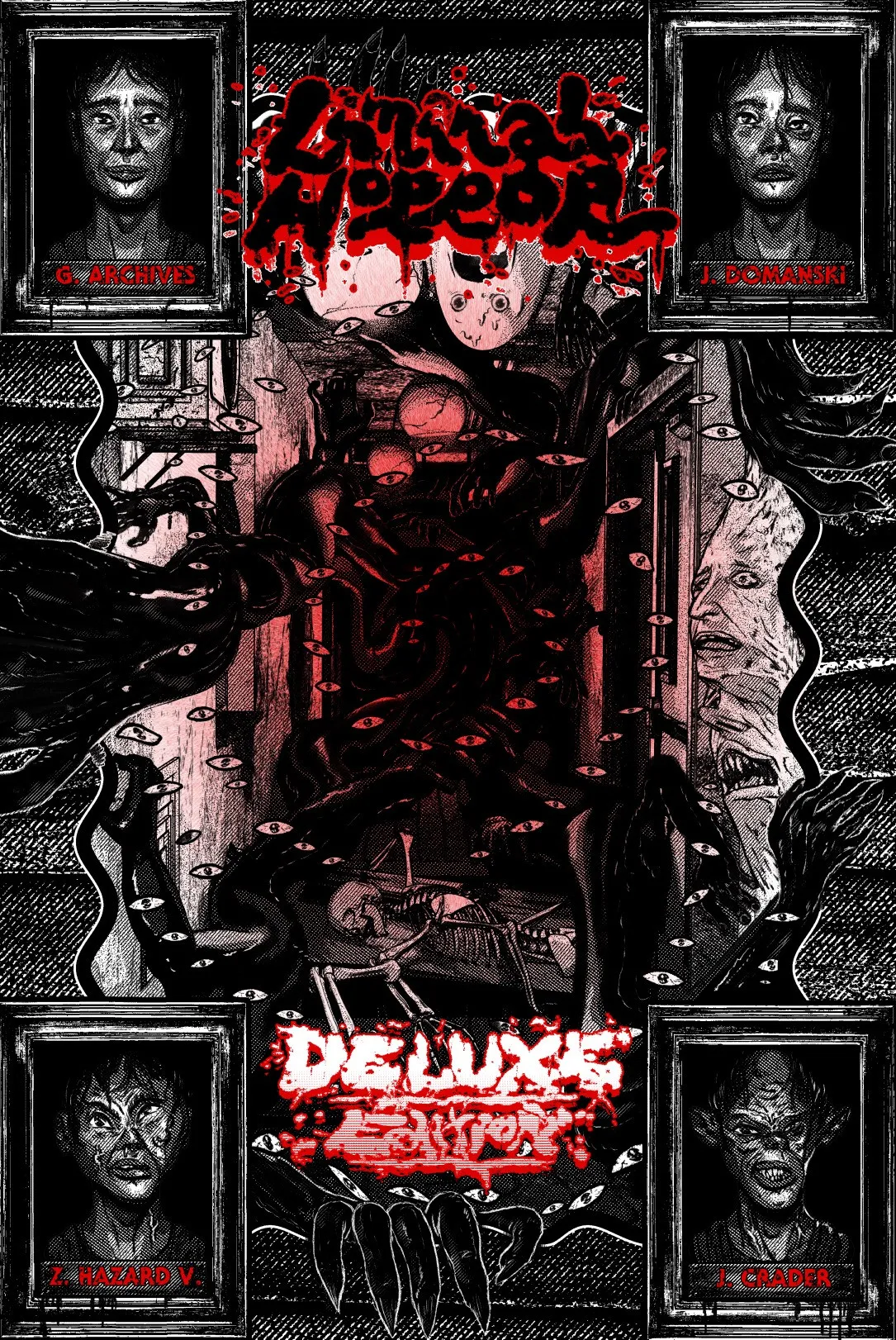
Excited by the announcement of the upcoming deluxe edition of Liminal Horror, I'm thrilled to share an interview I did with one of the authors, Goblin Archives. Hope you enjoy it as much as I did!
This interview was originally posted in Spanish in 2024.
Mario | La esquina del rol: Goblin Archives welcome to La Esquina del Rol. I appreciate the time you are taking for this interview. Seriously, thank you very much!
This 2024 seems to be an amazing year for Liminal Horror. But, before talking about your game and its promising future, I would like to know a little bit about Goblin Archives, about how you got into role-playing games and what is your place in the indie role-playing scene?
Goblin Archives: Thanks Mario, I'm really excited to get the chance to talk with you!
Funnily enough, I didn't play roleplaying games until I was an adult. In middle school I did go to a friend's house and read through D&D 3.5 players handbook and dream about playing, but it never ended up happening.
Growing up I was really big into comics, sci-fi, and fantasy. I was a voracious reader and had read a lot of the things that inspired early ttrpgs (unknowingly reading a lot of Appendix N).
When I was older (about 24-25), my friends were interested in playing D&D. So I decided I'll make it happen. I bought the three core 5e books, and the Mines of Phandelver starter set, and decided to make it happen. We played monthly, my table was always open, sometimes getting up to 8 people. My friend group at the time was mostly tattooers and artists, but any friend who was interested got an invite (and came to play at least once).
It was interesting, since I had never been a player before running a game. Another really formative part of that was that by nature of my friends and trying to keep it open, I ended up holding most of the rule (being one of the only ones at the table to read them) and worked hard to help others navigate play with minimal background/understanding of the mechanics. My day job is as a teacher, so helping facilitate understanding and getting others toward achieving understanding is what I do every day.
Over the years what I ran changed, eventually getting to where I am now, playing mostly OSR style gaming, and really running a lot of what I am writing for Liminal Horror.
As for my place in the game scene. As the creator of Liminal Horror (along with my writing partner Josh Domanski) I spend a lot of my time writing for and supporting Liminal Horror's growth (both in English and in multiple languages). I like to think I'm a supportive figure in the scene who tries to offer help where I can and uplift others.
Mario: It's interesting what you say (btw, I'm a teacher too!), I wonder if you think that later entry has influenced you in some way to enter the role-playing scene with a fresh perspective. Because if I like something about your writing and the incredible Josh Domenski, it is that ability that you have to deconstruct certain concepts and redefine them. We see it for example with the themes of sanity and other themes of mental illness that were put aside, and reinterpreted as stress for Liminal Horror. That to me was incredible. What can you tell me about this topic?
Goblin Archives: I do think that coming in to the scene older allowed me to approach topics with a different lens and perspective than if I started out young.
One is that I am not married to any one concept or traditon and am instead more open to trying new and unqiue approached.
One major influence for me was the fact that the first few years of my engagement with ttrpgs was really about playing with my friends and fun at the table. This has placed PLAY at the center of my drive and importance. In the end, all of this work and scene comes down to friends at a table having fun together. I try to always keep that perspective when writing ttrpgs. It is also why I love talking with people as they prep or reflect on running something I've written. My first part of advice is always to make it theirs and make it work for their table.
In terms of Josh and I's work in modern horror, we've found it really important to identify what themes and ideas resonate with us and then figure out how to make them easy for others to bring to their table.
When it came to the classic "sanity/mental illness stigma mechanics" of other games, it never sat right with me about how that took something that people live with and made it monstrous or scary. Many people close to me are neurodivergent or live with different impacts that other games had used as a punishment. When writing my own horror game I didn't want to go that path. Instead I wanted to lean in to how battling with horrible things will inevitably change you and often make you more like those things. Stress damage becomes fallouts which are ways that you are narratively becoming like the things you fight (a dead god growing inside of you etc). Not only did the Investigators begin to mirror the themes of the story (different types of fallouts for different types of horror) but it created narrative threads for play that avoid being problimatic stereotyping.
Mario: I think the decisions you made for the design of Liminal Horror were very wise. Well, let's go deeper into Liminal Horror. That all our readers want. Liminal horror is built on the chassis of Cairn but with a couple of mechanics that tie the game to the genre. The Fallout mechanic is brilliant, what can you tell us about the creative process of this and other mechanics that are the soul of Liminal Horror?
Goblin Archives: I chose Cairn for two big reasons. First of is that as a ruleset I think it is pretty perfect. It is straightforward to use and easy for others to understand. Players can quickly get into the story at the table and the rules help them engage in the narrative. Technically everything fits on a single page. This goes back to my days running 5e for friends where I held most of the rules as the GM, helping them navigate it. With Cairn (and by extension Liminal Horror) players are able to pick up and understand how things work so easily.
The second reason is I was really inspired by Yochai's interview on The Lost Bay. It really made me feel like I could make things as well, and it helped me start to have a vision for what I could write.
I realized I wanted to do modern horror as it was a genre I was getting into at the time, and I noticed there wasn't a lot of modern horror within the OSR style space.
I definitely wanted some sort of reflection of the weird and horrifying, and so I created the Stress and Fallout mechanics to reinforce that. It acts as one of the main levers for character change, and reinforcing theme and genre. As Investigators get exposed to weird and horrible things they take Stress damage, and eventually as that breaks down they get Fallout (a narrative and mechanical change that makes the Investigator more like the monsters they are battling against).
In the Investigators Edition (and the upcoming Deluxe Edition), we added a Wounds mechanic to mirror the Stress/Fallout but for physical damage. When I initially wrote LH I had dropped scars from the mechanics. After writing and playing I realized I did want something that reflected the physical damages characters go through in horror movies so I made the Wounds analogue. So when violence breaks out there is very real bodily stakes.
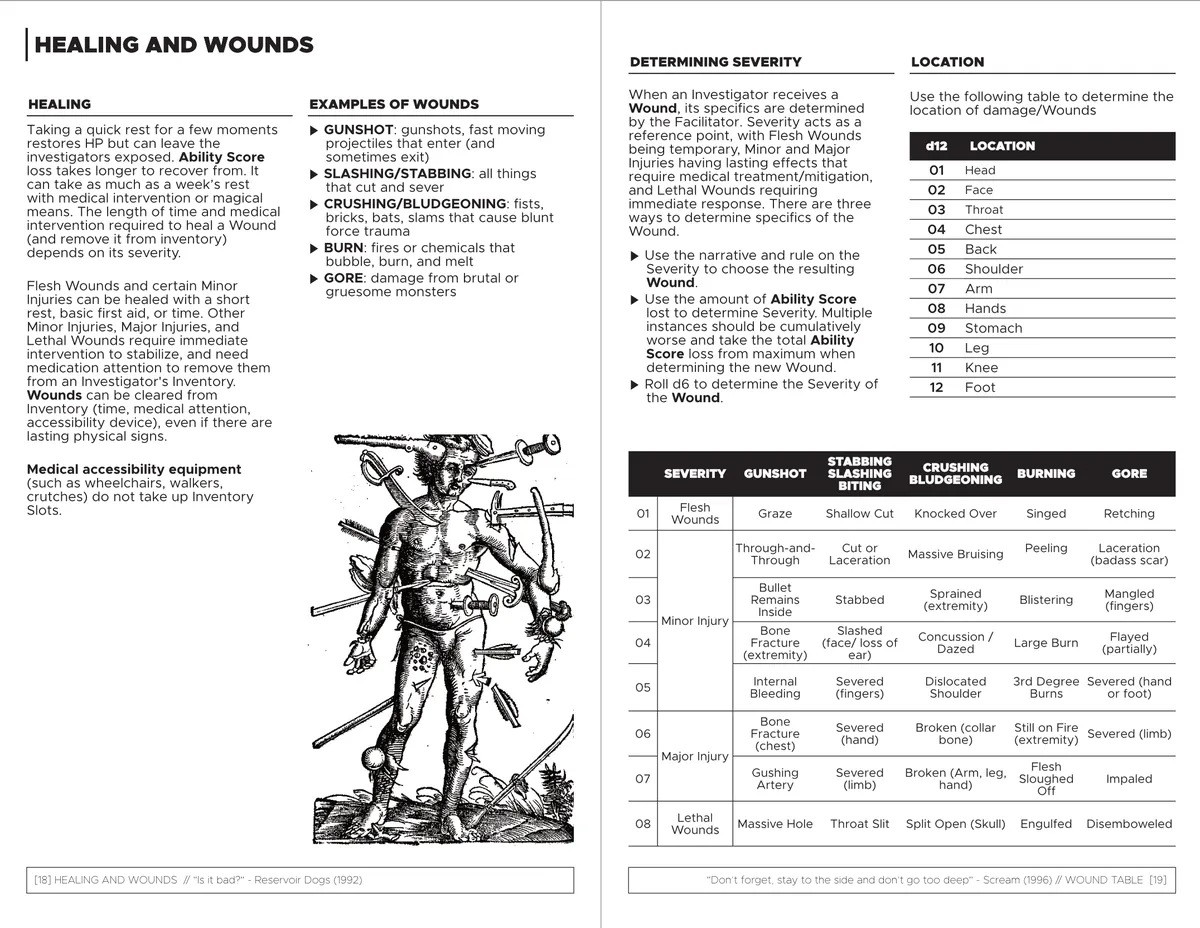
Mario: Yes, I totally agree. The wound mechanic thing seems to me to enrich the game a lot. I think it was completely worth it to be added. I really like it. Congrats.
When I started translating the investigators edition into Spanish, there was a section about the liminality of the characters that you wrote that seemed fantastic. You know the one that talks about the difference between the liminal space and the liminality of the characters in relation to the game. Already reading this whole new edition allows me to perceive a more mature writing and more focused on what the game is. I wonder if you could explain to us what that transition from one edition to another has been like for you and Josh, and what the next move towards the deluxe edition will be.
Goblin Archives: It’s been a really interesting progression. When I was writing legacy edition i feel like I put out a clean system that worked very functionally for modern horror. It wasn’t until josh and I started collaborating and writing for liminal horror that I uncovered the heart of what the system is. The focus on how character change. Many die, but a lot survive, forever changed by the experience. This discovery really came to light as I wrote and ran Liminal Horror time and time again. Its funny. I ended up learning my own system by running it at the table.
I can confidently say I’m still the person who’s ran liminal horror the most (I playtest every module with my groups). I find that play really showed me the core of what LH can be. And what I found is that it can adapt to any genre of horror and keeps the focus on how the characters change through play.
This has helped me become a better writer. But honestly the evolution of writing really stems from the collaboration with Josh Domanski. As we wrote the bureau we fell into a great pattern of cowriting and inspiring each other. It is truly a natural back and forth that makes the end product better.
Josh is a phenomenal writer and designer with an understanding of how to support players and facilitators.
Mario: In my last interview, I talked to Andy from Pandion Games about how he collaborates in creative processes with René-Pier Deshaies It was great to understand how they work designing games. Personally, I'm very interested in those creative processes between writers or designers of role-playing games. It's very interesting to me. As people say: two heads think better than one. In your case, I see a very interesting synergy between you and Josh. I think that both of you together have taken the adventure modules for the liminal horror to another level. Hopefully, at some point, we will have them in Spanish because I think that's really the great work you are doing together. But, well, I would like to dig into your creative process. How is that creative process between both of you?
Goblin Archives: It has been the single best experience working together with Josh. If I have to determine the root of it, it’s that we trust and believe in each others vision and ideas.
Josh reached out with the idea for The Bureau and we ended up cowriting it. And from there there hasn’t been a moment of looking back.
Often we’ll approach project by having one of us come with and idea and we’ll workshop the framework back and forth until there’s a framework. At that point we divide and write, then circle back around and provide feedback.
It works so well and pushes me to be the best writer I can be to rise to their level.
Also we’re in constant contact. Talk long and sending each other things/ ideas every day (our working slush pile is quite large).
It works really well and what I’d attribute the quality of LH content to
Mario: That's so cool. I really admire your work together and I'm looking forward to talk a little bit more about the next module coming in early May.
But, before we get started on this topic. I would like you to explain us a little bit what is this new era for Liminal Horror that you constantly mention and what are we going to see in the Deluxe Edition?
Goblin Archives: The new era is pretty exciting. It started with the Investigators Edition which updated, edited, and cleaned up the rules. The physical to as a perfect players zone and has everything a facilitator needs to run LH. It also is available free as a pdf and on the website. It will continue to be in print for quite a while.
As for the Deluxe Edition, it is our new foray into hardcover texts and includes the Investigator Edition (core rules) along with a bunch more thing for facilitators and the table.
It expands a new magic system, a ton new fallouts, archetypes for characters, essays on Creating, Running, and Adapting Mysteries. It has the catalogue of the strange which has factions, monsters, resonant artifacts, allies and adversaries.
There is also a setting included (The Haunted Pacific Northwest) with adventures, major cities, location, story seeds and NPCs.
Ending the book is a ton of appendices, additional and supplemental rules, and tables.
Josh and I are doing the writing and design Jarrett Crader is our editor and Zach Hazard is art director.
Mario: Wow!!!! Awesome!!! it's really something big!! I'm so excited!! You have a great team working on it. I don't know... I don't know if this will be a crowdfunding or not, but I will be the first backer of the deluxe edition as of now hahaha seriously! as of NOW!
Let's move on. A few days ago you revealed the cover of Hungry Hollow illustrated by the really amazing Amanda Lee Franck. I know you can't tell us much about it, but if you could give us some scoop to the community. Some overview or hint about what we are going to see in that module would be amazing!
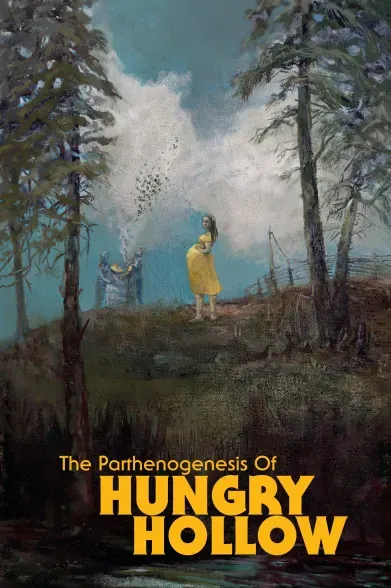
Goblin Archives: So this module took inspiration from the classic N1 module Against the Cult of the Reptile God. We read that and were inspired to give it our own modern horror spin. Tearing it down to its bones and looking at what made it so beloved (community fractured apart, some changed by an unknown force, the reveal that there still are people inside those cultists minds).
Taking inspiration from my drives to the coast in the pacific northwest, Hungry Hollow is a small community on the brink of doom.
Some spoilers here, but the heart of it is that a former Investigator (someone who is like the players) found a Resonant Artifact (Liminal Horror's dangerous magic items) and has used it to grow a god in hopes of birthing it into this world.
Using parasitic flesh bees, she has kidnapped and begun growing her "hive" in preparation for the birth of a god. Taking inspiration from nature (Carrion Bees) we have these bees that implant themselves into people and convert them to the hive. There are also a lot of body and wet horror elements as the converted "Apiarists" consume raw meat to regurgitate it to make meat honeycombs.
While we present a few different ways to set up the module for players, one of my favorite is that this can act as an adventure for Investigators that have already battled the weird before. This isn't their first outing, and that level of experience brings with it a sense of understanding of the stakes.
And what's the fun of an interview without an exclusive, here's some never before seen art from the module:
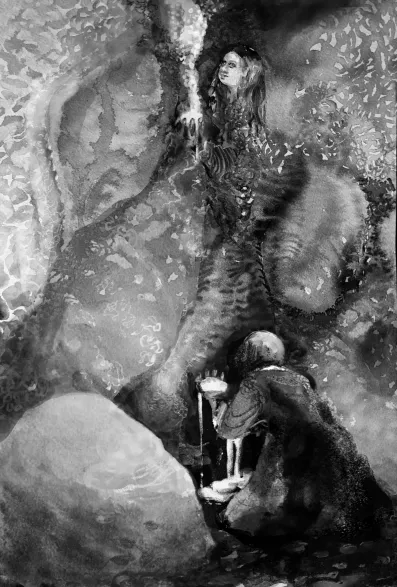
Mario: Amanda Lee Franck is amazing! I love the art direction of the module and I understand that we are going to see with this module what will be the Liminal Horror line of modules, in terms of art and content, isn't it?
Goblin Archives: As the team was developing both this and the deluxe edition, it was time to really decide what we wanted the line to look like in this next era.
The major thing is that going forward we are going to have a unified theme in terms of releasing hardcovers (6x9, with similar design and styling). This departs from the previous zine format. That form did us so well, allowing us to grow within the constraints.
These next books are a departure for us, learning a new style and format. The extra space will allow us to stretch our creative legs in terms of scope and scale.
After the hungry hollow will allow us to start setting the design foundation for the future line (we got some cool fonts and ideas in that area).
Josh and I have a pile of ideas for what’s next that will really thrive in the expanded hardcover format.
And like hungry hollow (having Amanda do art) and the deluxe edition (with Zach) we will continue partnering with artist to who’s work and art will push it to the next level.
Mario: Nice!!! I really think it's a good step, the game gained a lot in the previous format but as I said early when I read it while translating it I see that it's a game that is growing.
Well, let's move on. I have a couple of questions from my patrons.
The first question is by Caligaes, he is a mexican game designer and creator of Xeno RPG, a micro-game on one page inspired by alien movies but in his game you are the alien, yeah! it's pretty cool.
He wants to ask you what you like the most about Liminal Horror RPG? Either mechanically or about the game itself.
Goblin Archives: One of the things I like most about Liminal Horror (and especially running it) is that since it is modern horror you get to pull from things that your players already have a background understanding of. If I open a scene in a convenience store at 3am, my table is instantly transported to it because they've experienced it. The cognitive load for description and visualization is lessened, allowing players to settle into a sense of understanding of place. Pulling on that sense of normalcy and understanding allows for when you throw the weird, fantastical, and horrifying it creates a true juxtaposition.
From a mechanical standpoint, I love how Fallout mechanically and narratively showcases how characters change to become like what they are battling against. Investigators who survive will be very different than how they started. From bodily harm to metaphysical they often have to make tough choices in order to scrape by and survive. It often creates a sense of players getting excited for not so great things happening to their characters in service of a good story.
Sidenote: You may notice that a lot of the appendix N and touchstones for Liminal Horror are films. This is because those are baked into the DNA of LH. Selfishly this is a reflection of how I GM. I often describe where the camera is (and how it moves). Sometimes I also describe what the audience would see in a scene (vs. the characters). Liminal Horror at its core is a system that allows for ttrpg creation of different horror sub-genres.
Mario: Yes, I have noticed. Even the basic book itself has on every page little movie quotes. That must have been a lot of work. But, it was nice to discover each quote as you turn the pages.
The second question is from Viejo RPG, he is also one of the patrons of Liminal Horror (we thank him for his support!) and in general of the project we have as La esquina del rol.
Well, his original question has to do with the magic of Liminal Horror (Legacy Edition) and about how much it was present in your own games with your group.
This question I think is an interesting question that we are going to modify a little bit because our readers are going to find out that the magic system has disappeared in the investigators edition. In the new edition magic items are used which are called resonant artifacts. Could you tell us a little bit about this issue to clarify to our readers the reasons for these adjustments from one edition to another.
Goblin Archives: Magic is an interesting one. It was such fun in it's original form (with generating words that then made up the spell). I only ever used it the first time I ran LH (in the original plague of frogs). Grappling with what the spell "Creeping Gate" was presented a ton of fun as the Investigator revealed to his compatriots what he was able to do.
For Investigators we dropped Magic for two reasons.
- I didn't think it should be a core ability that players start with as that goes against the idea that they are regular people becoming weird.
- We were going to shift away from the old form and make a list of example Magic Spells that were simple descriptions. That has made it into the deluxe edition and a few "monsters" have access to right off the bat (Liches, Witches and Pact: Warlocks).
Resonant Artifacts are definitely the key aspect of "Magic" that is available to players. These "magic" items are tied closely with other horrors presented in the Deluxe Edition's "Catalogue of the Strange"
Their connection with other dread forces make them powerful and dangerous. Resonant Artifacts aren't just used by players and their influence may take many forms. Liches make them to help sunder their mortality. They may be an aspect of a dead god. Resonant Artifacts may act as a conduit for a Curse to manifest. Some with a form a sentience may be a patron to a pact warlock. Their use may twist and change the body of its user or make its victim into something no longer human.
Often, a Resonant Artifact is at the center of a problem or mystery. Its influence bringing danger and doom.
We have a bunch of new Resonant Artifacts in the Deluxe Edition along with collecting in the Appendix all the RAs from previous publications.
Mario: If I'm being honest with you the original magic was what I liked least about Liminal Horror, not because of the mechanics themselves. I just felt it didn't quite fit. This resonant artifacts thing, I like it better (reminds me of ItO's Arcanum) and I think as you say it fits better with the idea you have in relation to magic and characters at the beginning of a game.
Another neuralgic point worth discussing with you, is that positioning you do in the book in that they move away from cosmic Horror, so to speak, and embrace modern Horror. It sounds great, but in practical terms what does this new emphasis mean to you?
Goblin Archives: So that is definitely an interesting one. The use of cosmic horror in the legacy was really a holdover from creating a modern horror OSR game (and a call back to the largest one in the space, Call of Cthulhu and Delta Green). In practice I never really wrote anything cosmic horror, so that framing was only a touch point in the original text.
Liminal Horror as a system has been something that I learned through play and writing adventures for it. As I spent more and more time in that space, I realized that it is much more about adaptable modern horror (to fit different sub-genres) where you spend time with characters who change through play.
This realization meant I really needed to eschew the cosmic horror specific references and instead frame it as something with a wider scope.
Mario: Yeah, I just really feel that this investigator's edition and from what you've told me the deluxe edition represent the coming of age of the game. Many congrats to both you and Josh. You guys are doing amazingly well.
Just to conclude this interview, I know you have plans that the community wants to hear from you. A Jam is coming, hungry hollow is coming, the Spanish and French edition of Liminal Horror is coming and, of course, we already have our own repository of the game! But, what's in Goblin Archives' mind for Liminal Horror in the future, and of course, how has the weirdness changed you?
Goblin Archives: I’m so excited for this next chapter. Hungry Hollow is a module I’m so proud of and I can’t wait to see people dig in.
The deluxe edition has been brewing for a while now and between Josh’s essays, my going full tilt lore word, Zach’s art throughout, and Jarrett’s editing it’s going to be truly special.
As for future works, we want to collect the original modules together into something new, with a connecting tissue between them (maybe a “The Fall of the Bureau” perhaps?).
Josh and I have a few projects that are cooking and it’ll be interesting to see which one comes up. An exploration into a city specific hardcover sounds nice as a deeper dive into Bayocean. I’ve hinted at an americas spanning collection of interconnected adventures and monsters which now I’m wondering if may be the next jam.
As for me, the biggest change I’ve found is that fully embracing sharing my voice and weird ideas with others is both fun and wanted. And I don’t think it’s a change since it’s core to who I am but really leaning in to the fact that I love helping others achieve their dreams and want to support as much as possible.
And for a send off…here’s the cover that Zach is working on for the Deluxe edition.