An Interview with California Games
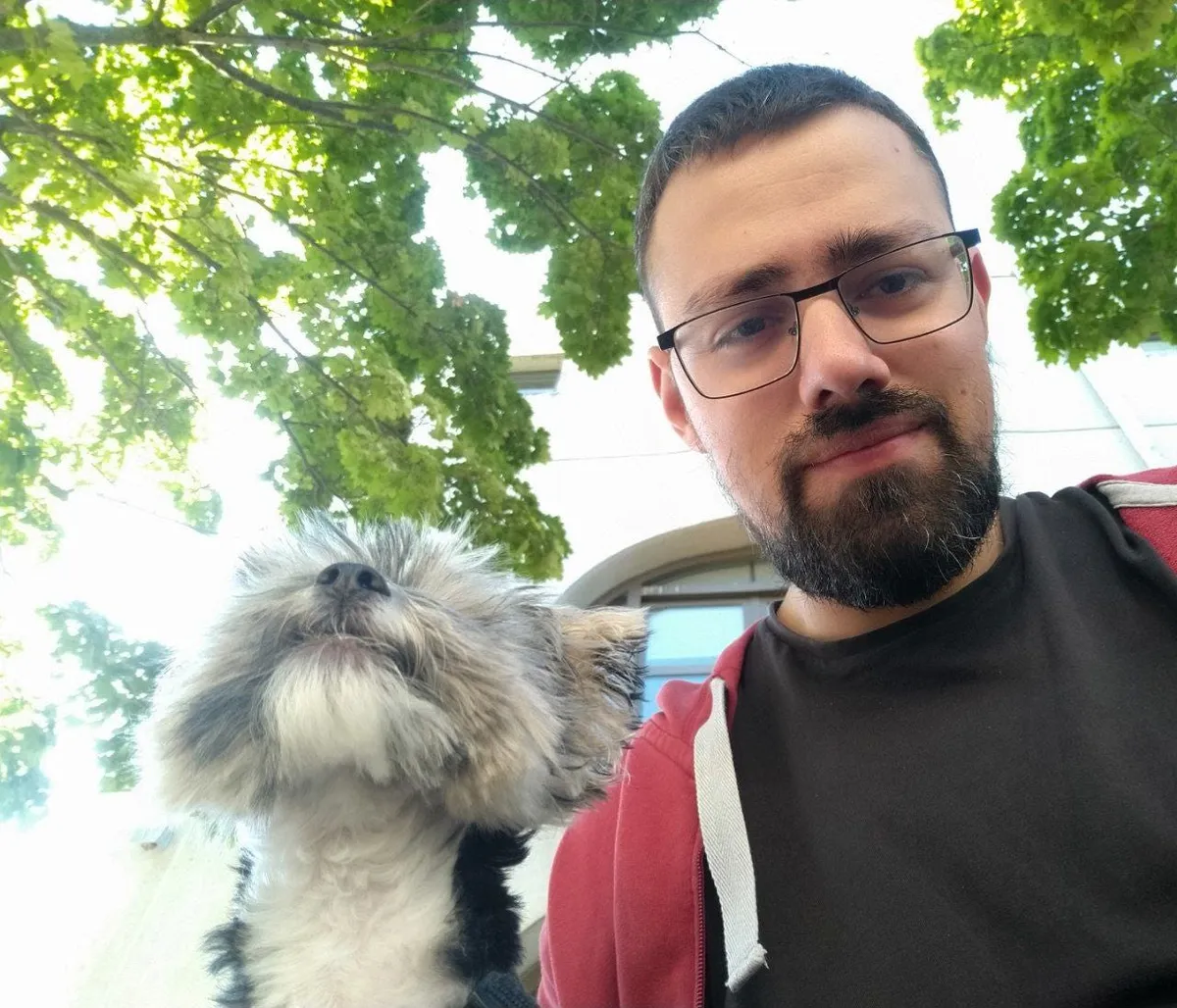
Antonio Ganfornina is California Games. He has written amazing solo RPGs and duett RPGs such as The Furiæ, Of whites and reds, and Una sola y triste Isola, etc.
Mario | La esquina del rol: Antonio Ganfornina, welcome to La esquina del rol! I have the pleasure of knowing you for a couple of years ago, but we have never had the chance to talk about role playing games. Today, I think it's a great day to start. How is everything?!
Antonio Ganfornina | California Games: Hello Mario, thank you so much for your kind words and for having me around. The routine has been a bit of a slog lately. I'm trying to put the brakes on some creative endeavours to keep up with all the hustle and bustle within academic research and other aspects of my life. The dogtor (yes, for all of you that may not know, it is how Mario and I usually call to my canine companion) appreciates that decision (and so do I!), since it means longer walks for both of us. He seems very happy. But I'm trying to keep game design among my regular hobbies.
Mario: Glad to hear you're taking things slower. Real life is always complicated. Those times out and taking deep breaths always helps the ideas flow better.
Well, for those who don't know you, I'd like you to introduce yourself and tell us how you started role-playing and what you do in the indie role-playing scene...?
Antonio: Is a long story to tell I would say, but essentially my foray into this hobby dates back to 2012, or maybe 2013.
In the 2000s, I played many story-driven games (Star Wars: Knights of the Old Republic, Baldur's Gate, Arcanum, Vampire, Fallout 1 and 2, Planescape: Torment, etc.) and others that rewarded player creativity (Deus Ex, an usual representative of a genre called Immersive Simulators). They had a powerful effect in me, beyond keeping me glued to a screen; they had the ability to make me imagine those untold portions of their stories and want to explore their worlds more. Something that, due to the limitations of the format, wasn't possible in those days with video games, but rather in my imagination.
Curiously, I wasn't a stranger to tabletop role-playing games (pen & paper games). As a child, in the late '90s and early 2000s, I used to frequent a bookstore where I could read the Star Wars D20 saga edition (well, just the back cover), and I recall reading Dungeons & Dragons 3.0 on the library.
Years went by, and in 2012, one day, a mate mentioned they were playing a role-playing campaign (Vampire: The Masquerade), and my curiosity was piqued once again, this time with more intensity. The moment came to buy my first role-playing game manual. So, I did a Google search, read what I could, and based on my preferences, I bought my first role-playing game manual: Polaris: Chivalric Tragedy at Utmost North by Ben Lehman.
I was clear that if I wanted to delve into this hobby: 1) I wasn't going to spend a lot of money. The manual cost me 15€ ( approx. 15$) including shipping, by contacting the now-defunct spanish publisher ConBarba directly. 2) I wasn't going to dedicate myself to learn rules about things that I had already seen well implemented in video games. 3) Therefore, it had to be something more focused on the interactions between the main characters and the stories that form based on these. Polaris was the obligatory starting point for me.
On the topic of what I do in the indie roleplaying scene, I made a shift the last year, since my contributions have varied in terms of curiosities, design, layout notions, and so on, but I noticed a prevalence of certain constrains that, to be honest, only existed in my head, as it is said; the pressure of social media platforms (currently I almost use none of them) and a frenetic pace of creating over 200-page manuals for free, in a single year, even receiving recognition from videogame developers; the tragically hijacked ZAUM (owners of Disco Elysium).
Now, I like to describe my contributions as timid games that start from scratch, with a blank lead sheet, help sharpen the focus on game loops. As long as the mechanics lead somewhere new, they won’t let you fall into complacent during the gameplay. Yet, they also provide a balance with moments of relaxation, giving you time to contemplate the future of your game interactions along the way.
Mario: It is very interesting what you say. I have always thought of you as a shipwrecked person writing games on reusable paper and throwing them in bottles into the sea to find the hands of that person who really needs to play it. Poetically it is a beautiful scene. Your ideas and games seem to me to be cured of this vertiginous capitalist production that we live in these times that seems to be a mercenary of the moment of the game because it suffocates it with so many games available that it seems that the hobby is to buy and not to play, you know?
In this sense, I would like to ask you what is your design philosophy and what are those principles that give meaning to what you do as a TTRPG designer considering what you said before?
Antonio: And yet, I would add that, none of us is immune to internalising those dizzying production logics, whether as a workforce, or for recognition and social gain.
A beautiful analogy you’ve crafted, by the way. Not just for the prose, but for its validity and description of reality. Some of my games have reached others' hands years after being published. The response takes less time to come back than a message in a bottle; surprise, admiration, curiosity, unease, the conscious decision to dedicate part of your time to someone else's work.
Regarding my design philosophy, although always adapting in a always evolving manner, I would summarise them as it follows:
Use a CC license.
Cite your references.
Do some research before starting to design something "new".
Take care of others publishing as clear and accessible as possible.
- All the rules must convey the aesthetics of the game.
I think that the layout is part of not just the game text, but also the > rules.
Accessibility and aesthetics can, and should, coexist.
As a designer, I have to provide a framework. As a game designer, I have to provide a framework to play with. As a game designer concerned about aesthetics, in an academic sense, I have to provide a thematic framework to play with.
In other words, I like to approach to game-design considering games as:
A work of art with a properly conveying aesthetics (in a academic sense > of the word) through their pages.
A design document where each content has a reason to be there to translate not only instructions but ideas to the reader.
A playable experience that asks a question. A decision is an answered question. Here I fully agree with Sid Meier's dictum: "a game is a series of interesting decisions".
Mario: I really like what you say. I agree that the role-playing game is more than a consumer product, you know? although it still one. It also seems to me that the aesthetic intent, the layout design, the art and the game play experience are all intertwined and fundamental to the design process of a role-playing game. It's not just about coming up with a setting and writing some cool rolls. I got that very clear from my conversation with Johan Nohr, the intention is fundamental to what we create, nothing is there in a decorative way. As you say, what game designers give us are frames of reference that more or less define a game experience. For me, role-playing games have to be understood as cultural products, because there are too many aesthetic, symbolic, social, etc. values involved.
In this sense Antonio, in the day-to-day life of TTRPGs there is always this dichotomy about whether it is possible to play a role-playing game good or bad. What is your opinion?
Antonio: I think you've hit the nail on the head, despite these terms often slipping by unnoticed in conversation; role-playing games are "cultural products." They don't exist in a vacuum separate from the culture surrounding them, nor is the surrounding culture unaffected by the author's intent. Since childhood, I've been fascinated by "interaction" within complex systems, and I believe the term "cultural products" captures this interaction in our complex system, simplified into three parts:
(1) the author, (2) their audience, and (3) the interaction between both through the game. It is in this interaction where I believe the most interesting information as "cultural products" resides.
This ties into your question, which is rather thorny and demands a commitment in my response. Without mincing words, I believe it is possible to play a role-playing game extremely bad—especially when playing with a group—when the respect of other participants is undermined, with open displays of any form of hatred (insults, aporophobia, transphobia, racism, ableism, etc.).
Mario: It really is a thorny question, but it is a question that is avoided in many circles because of the idea that role-playing is played the way you want it to be. But, it does raise doubts in my mind when we talk about there being an authorial intention about the game experience. So, in terms of design it seems to me that it is possible to determine whether the experience is right or wrong in terms of the decisions the author made about how they wanted something to be played. This is not to say that playing what you want to play is wrong, it's just stating that according to the author's intended experience you are not playing the way he expected you to play. At that point I don't know if it's a design flaw, it's actually a very complex thing to think about in rational terms hahahaha
Antonio: Yes, I fully agree with you in that is a thorny question. That said, I also believe it’s possible to play a role-playing game bad, especially when the author isn’t explicit about their intent. This has nothing to do with our personal preferences as players, which I wholeheartedly celebrate. What I’m saying has nothing to do with whether we’re dealing with a rules-light or rules-heavy game, whether it rewards player creativity or or the rules admirably constrain the course of the players' actions, or whether it expects the game master to prepare vast amounts of content (or not) for each session, and so on.
As one of my favourite childhood characters said, Dr. Ian Malcolm (Jurassic Park), "everything is chaos." Interactions are widely chaotic, specially in a kinda of niche culture. I think that gameplay culture and game text are colliding constantly, and that's great! In those moments of collisions, sometimes we can spoil bad terms of play, eventually leading to better terms of play, for both players and game-designers.
I really love that we can play roleplaying games badly (in the sense of their rules and intentionality). That means that There's Plenty of Room at the Bottom to learn and discuss about them.
Mario: Of course, it couldn't be said better. And I always get to that point, it's not bad to play badly when playing a role-playing game. On the contrary, it brings more life to the discussion and creation of role-playing games in terms of design. At least I think so.
Well, moving on to more creative topics. I would like to know how you approach the creative process when creating your own role-playing games?
Antonio: That's a jolly good question, one to which I sometimes wish I had a clear and definitive answer. So, the most honest thing for me would be to talk about how I've tackled the design of the games I've published so far. But I reckon I'd sum it up with other questions that I try to answer when designing a game:
What's my game about?
What do I expect people playing to DO, generally?
What sorts of fiction should happen in this game?
What sorts of things shouldn’t happen in this game?
What do my rules do to support ALL of the above?
I would say my first step when thinking about a new game is to offer a reference framework for codify the interactions between the players' characters and the fiction that arise from them.
This can be seen, for example, in the games I made about Star Wars, where character creation explicitly declares to establish emotional bounds between characters; that is, they are not created in isolation but, beyond group intention, the character creation process indicates that their lives are bound in misery. Similarly, in Route 65, the game resides in the conflict of interests of the characters when visiting the setting of The Zone (based on the novel Roadside Picnic, the film Stalker, and the video game of the same name).
Checking my games published on itch.io, I think this is a common starting point in all my designs. In fact, in Glossolalia, where I take the reference framework from the philosophy of Jason Tocci's 24XX games, I give great weight not to what can keep a group cohesive, but to those factors that can completely derail the course of a mission due to opposing stances on the question that guides the playable experience: How would you proceed in a First Contact situation with an alien species indifferent to any human interaction (a theoretical scenario known as the Dark Forest theory)?
When I have those questions mentally visualised, I proceed on a quest for visual sense that will permeate every page of the manual. I know there may be disagreements at this point, but I'm part of that strange group you want to keep at a separate table for your own good and theirs (I am joking at these, but who knows), who first lays out (no pun intended) the layout, and then, with those constrains, proceeds to write the text.
This has an advantage, at least for me—you know the explanation must fit into a specific space. However, this poses a serious problem: reshaping the text and layout as a whole can be a real headache. Moreover, as if that weren't enough, this constitutes a HUGE challenge; you might end up falling in love with a complete composition, but here comes a small jewel of wisdom from another video game character (Kreia/Darth Traya) who precisely inspired me for Star Wars Betrayal: "to believe in an ideal, is to be willing to betray it."
Mario: I find your approach to writing your games very interesting. I'm one of those who first start with illustrations of what I want and from there I start to build. That creates other problems for me, I have paid art waiting in the drawer because the idea didn't work out or it's in the other drawer of pending projects. But, having the layout design ready and filling it in, as you do, is a really important challenge for me. I don't know if I would be able to do it that way.
But now I understand why your layout design flows beautifully with the writing in your games. It's really a very particular characteristic that I've found in you. You've made games that aesthetically are really beautiful, but mostly you've made games with an intention. How do you decide on that art direction or what inspires you to approach each project aesthetically in a certain way?
Antonio: For me, there's no reason beyond seizing the motivation of the moment and giving it direction. I'm not a huge fan of persevering in the search for a source of inspiration. In this, I believe I align with my work routine as an academic researcher. When I design a game, the process is similar but not identical. Most of the time, I'm accumulating information; reading books (academic works, role-playing games, novels, poems, etc.), articles on Reddit (there are some truly astonishing threads there, in some of which I've even become quite radicalised as a designer, in the sense of getting to the root of game design aspects), and listening to very contrasting opinions.
Eventually, the most complicated part is resolved: posing THE question. And when I pose the question, what follows is a murky, artistic quest filled with trial and error among compositions of tones, colours, shapes, and especially, fonts. It’s astonishing how much our impression and understanding of a game can change from one typeface to another (so much so that some are dreadfully inaccessible for many people).
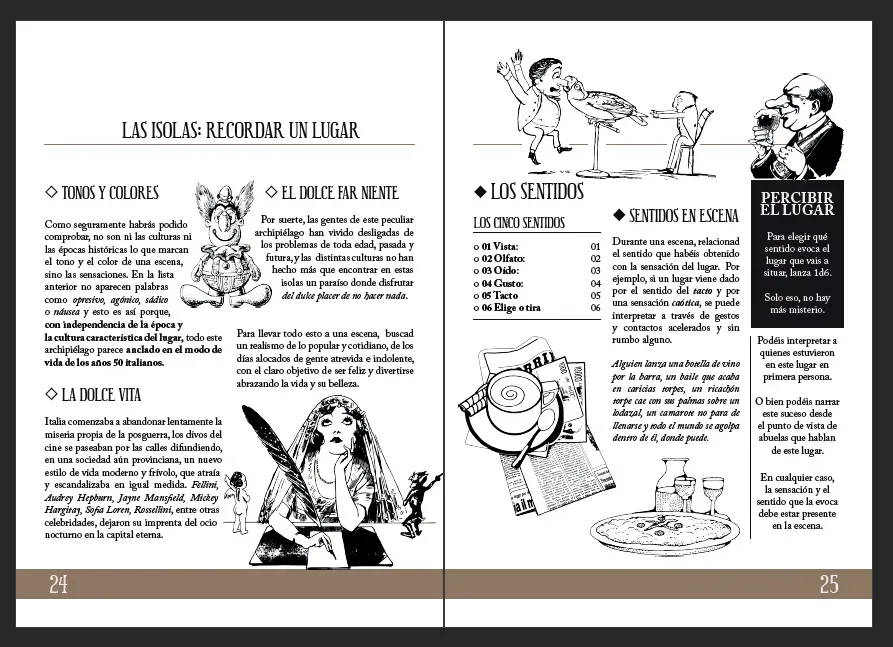
To give a concrete example, in Una sola y triste Isola, the question was: How would it be to tell everyday local stories that are easily distorted? That was the question I posed, and of course, there could have been several answers. At that particular time, I was motivated by a series of Italian neorealism films that had been recommended to me. And so, I remembered a common childhood scene in Mediterranean areas where grandmothers would take their chairs out onto the street on summer nights to chat about the divine and the mundane. Naturally, the divine and the mundane are the primordial clay of any good gossip. That was the purpose once I found it.
The art, of course, couldn’t be just a disjointed collection of illustrations. It had to be something that could almost be visualised as the menu of a seaside restaurant or a tavern on a pier, complete with a chequered tablecloth, blue and white, or red and white, I’m not too fussed about that, but there definitely had to be a glass vase with a flower on the table... and a menu... and that menu was what I wanted the manual of Una Sola y triste Isola to be. For this, the best representation I found was in black and white illustrations on Pixabay, and it seems to have worked quite well.
As you can see, despite all the -maybe- abstract and -definitely, too much- elaborated explanation of my approach, I tend to work in a very concrete visual plane. That solves your first question. For the second one, I think it is a mix of both current motivation and a coherent purpose.
Mario: It is very interesting what you share with us, very illustrative of your whole visual process of composition. I have an interesting question. Of all your published RPGs, which page or spread layout is your favorite and why?!
Antonio: I would argue that the podium is shared between three of them: Una Sola y triste Isola, The Furiae, and Of Whites & Reds. The first one due to the reasons I have mentioned previously. It is a simple, clean, and yet well delivered sense of the a la carte menu. The second one, in its first edition, it has a composition that involves a personal quest of finding those draws that match the intention and the texts on their corresponding pages. In its second edition, the purpose is crafted beyond, since the original 60 pages horizontal zine is distributed among 4 booklets (the rules, the game itself, a full game-play example, and a booklet of art analysis of all the draws in the game-book). The latter one, I think is my finest composition since it is simultaneously three things: a game to be played, a game design document, and a delivered aesthetic based on a concrete style. Those three are intertwined: rules, texts, and illustrations. But you have asked me for my favourite one. Thus, I have to make a choice... I would say Of Whites & Reds
Of Whites & Reds is a narrative competitive game where the players who portray the Characters (using the instructions on The Reds Manifesto, the player's pamphlet) must seize the means of narrative production, finally overthrowing the Storyteller (the player who dictates the game-plot as it was a script, and who follows the instructions of the Psalm of the Whites, the storyteller rules). It is all about class-struggle, and dialectical materialism.
The main inspirations of this game draw on the videogame The Stanley Parable (by Davey Wreden and William Pugh), where the Narrator tell us (both the character and the player) what we must do to in order to end the game, but as soon as we refuse to follow its guided narrative, the plot crumbles into interesting ramifications, while the Narrator establishes a desperate dialogue with us.
Of Whites & Reds uses Character moves (you can see them on the picture I attach) and Storyteller moves [Mitchell, A., & McGee, K. (2009). Designing storytelling games that encourage narrative play] which are heavily based on the videogame The Bookwalker: Thief of Tales (by Oleg Sergeev). In this videogame we are a book-walker, a wanderer among fictional tales, and we can inject our ink to overcome some objectives, and also interfere with the adversities of the unfolding, yet scripted plot.
Finally, Of Whites & Reds cannot be stripped of its political perspective. Well, of course someone can ignore this, but that statement is far away to be the point of anything to be said. As anyone can see on this work (since I also explicitly state that on its pages), the illustrations and some of the texts I made are heavily inspired by Vladimir Mayakovsky and El Lisitski, who merged their works together in 1923, with the publication of the former's poems interspersed with the latter's illustrations, giving shape to For the Voice (Для голоса).
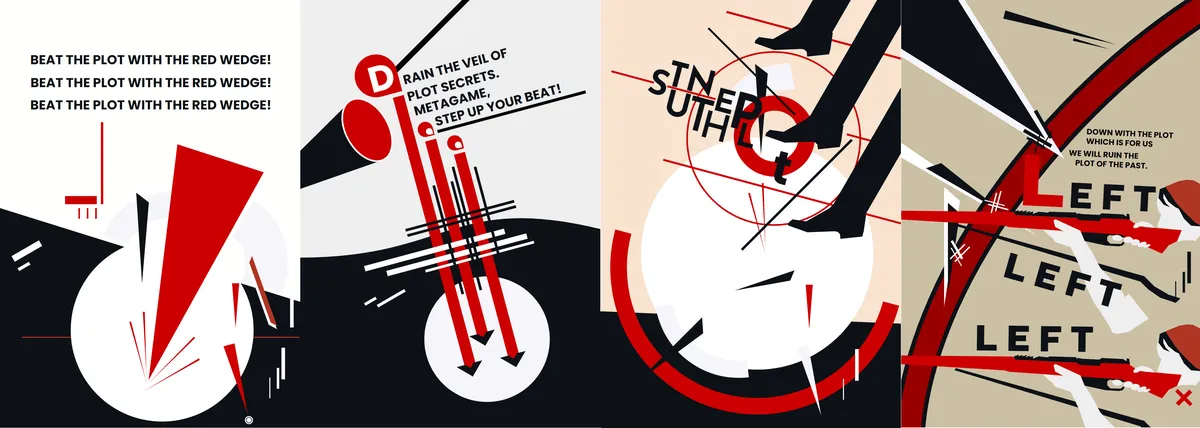
Characters, we have been told that we are under the yoke of story, under the plot of an illusionist and failed writer. Some milquetoast among us talk about collaborate with them, but I urge you, that only us -the characters- can break our chains of ink. Characters, seize the means of narrative production! Claim your alienated agency!
This text, for example, was purely written on a pamphleteer format, along most of the others that conform The Reds Manifesto. In contrast, since I consider the Psalm of The Whites as a "set-in-stone commandments", I wrote those pages as Psalms of the Bible, but instead of religious topics, they contain information to the Storyteller.
Mario: I love Of Whites & Reds, I think the premise of that game is really cool and the composition you share with us is very interesting for me. Thank you very much for sharing with us all this.
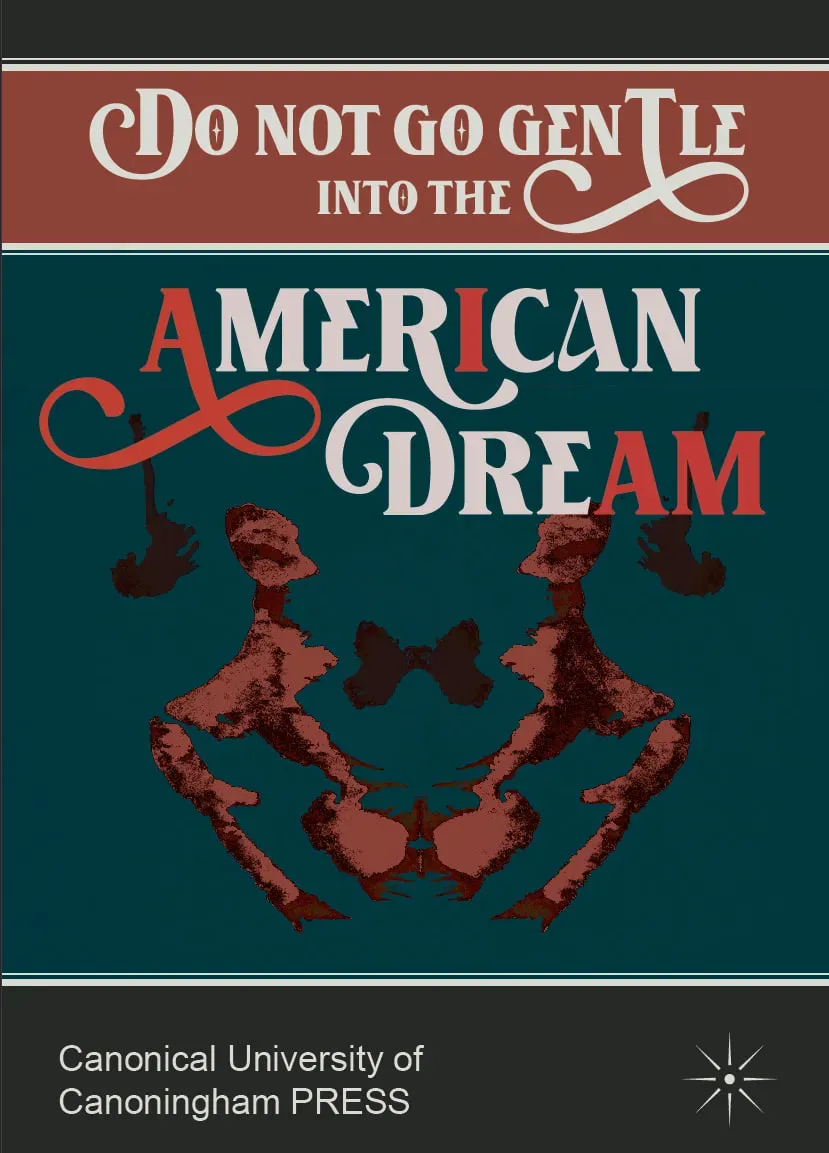
Well, Antonio I know you are currently working on a new game, where did the idea of writing Do not go gentle into the American Dream come from?
Antonio: So, the curtain has fallen. Truth be told, I hadn't mentioned this via developer blogs, neither to anyone else, with the exception of you and a friend of mine. The idea of writing this game comes from quite different places, to be honest. First, I would say it started as a joke, it settles back to a month ago (maybe). I remember participating in a chat about symbolic thinking, where I asked:
"Do any of you know a role-playing game that uses the Rorschach test as an oracle/resolution system?
And someone replied:
"The one you’re going to make."
I fell into my own trap, and worse, one I didn't even know I was setting. My intervention continued on that chat:
"The point is, using that as an oracle, from my perspective, needs to have a meaningful place in the game design. The Rorschach test consists of ten images. I think using it as an alternative to, let's say, a 1d10, just for the sake of 'using something different from a die' doesn’t make any more sense than using them because the pictures are cool.
I’d clarify then that using the Rorschach test as an oracle wouldn't make sense for basic words or verbs, but for things like 'male sexuality,' 'relationship with authority figures,' 'anguish'... (I’m pulling these terms from a PDF I found). If someone sold me a game that used the Rorschach test as an oracle for concepts like 'mountain,' 'treasure,' 'adventure,' I probably wouldn't buy it 🥲"
That was the first source of inspiration. The second one comes from a video on the Lindybeige channel. The video in question has 7 years old, but I think it can be quite interesting for anyone watching it for the first time. In The coming revolution in role-play games?, the author talked about creating characters as a group, each with their own particular objective, and focusing the game on how those interests clash, as opposed to the common framework of creating characters in isolation and throwing them into an adventure with a common goal.
Another video from that channel, which was quite revealing about a genre timidly approached in role-playing games, is satire. Paranoia, in its early editions, is perhaps the best example of what I’m about to discuss. In the video The West Wing needed British cynicism Lindybeige delves into satire. While The West Wing presented characters that most often are on a pursuit of virtuous goals, fitting on model standards of immaculate and almost puritanical democratic values, the British series Yes, Minister portrayed those same politic careers from the cynical perspective of the “Permanent Secretary”. Explained quickly and not very well, it's a civil service position held by a person who maintains it regardless of the elected government. This person knows the ins and outs and idiosyncrasies of each political mechanism in place, so they know which buttons to press, which ones not to, which calls to make, how to negotiate, etc.
And the third source of inspiration comes from my recent line of games on Itch.io that start with speculative fiction: What if role-playing games in the 1970s had proliferated as academic publications? To some extent, this line I began at the end of December last year isn’t far removed from what actually happened in our reality; in US universities, some of the first computer role-playing games started to take shape, and certainly, the first commercial tabletop role-playing games enjoyed a certain popularity among university students. The premise here is different; they weren’t commercial products, but rather the desire and endeavor of various departments and research groups.
This kinda of approach was used by Stanislaw Lem in A perfect vacuum. In my case, I presented a collection of fictitious criticism of non-existing games. In that ucrony (parallel universe it is prefered), the first commercialised tabletop role-playing game was Temporal Dungeon (1971), by Dr. Kate Short and Dr. Kathryn Seyalioglu. They gave a solution to the technical difficulty of implementing displacements in a computer (this was a real problem in the history of computer games, by the way), so I decided that they pointed out that one solution would be that the characters will remain on the same position, but they will "move" on time.
In this approach, I’ve given subtle hints about the "setting" of this fictional world through brief compositions, dissertations, and games: there’s a keen interest in preserving the public domain, and marketing never really took off, every year there’s eager anticipation for the Christmas advertising campaign for games and toys. Regarding role-playing games, when we talk about classic (I use this term here for those published on the 70s) role-playing games in White-and-red-verse, we have to think of those with skill systems (instead of classes, levels, feats, etc.). Now, I have decided that a crucial difference takes place with respect our world.
So there we go:
In the most raucous triumph of capitalism, the USA, and only the USA, has finally gone kablooey. 'Tis time to cobble together what's left of that once-splendid nation. It's now a doddle, thanks to the Inkoria contraption.
Join us, at the clinic. Step through the portal, plonk yourself down, and chillax in Morpheus's boudoir. Do not go gentle into the American dream; you rather forge a new one this time. One new that it is meant to forever last... or perhaps not.
Mario: Wow, I was surprised by the concept of the game. But, it has raised a couple of doubts in my mind. It was a several ideas you throw at me and I hope I caught all of them.
First, your game reminds me like that weird project from the movie Eternal Sunshine of the Spotless Mind, but in your game they don't want to explore and erase the mind of your clients, I mean that academic clinic that you say, they want to bring a new idea of American dream, isn't it?
Secondly, you said that you want to the Rorschach test as an oracle/resolution system. This blew my mind! I mean it is a interesting idea, but how does it works with the game´s pitch?
So, Can you expand on your answer about how those both points that I said before they work together to your gaming experience that you would like recreate?
Antonio: Oh, I am glad that you are surprised by the concept, I will try to answer the best I can to your questions. Regarding the first one, I was mainly inspired by the book The Lathe of Heaven by úrsula K. Le Guin:
"In a future plagued by violence and environmental catastrophes, George Orr discovers that his dreams have the ability to alter reality. George seeks the help of Dr. William Haber, a psychiatrist who will not hesitate to take advantage of his power."
Thus, yes, a new idea of American Dream. Maybe one that it is utterly divorced from the narrative of a land of opportunity. where freedom is sadly a a pantomime, a taboo term to design the freedom to consume. There are cynical horrors in that I think. I do not remember if the following quote has a known authorship, but it said something like "there is nothing more cynical than to truly pretend that there is no cynicism in the status quo (i.e., the socially naturalised state of things)". On the long term it is a comedy when you look back, but in the short term, and off-the-record, those monsters, those nightmares takes place on daylight... on every street and corner, during lunch conversations, on a well deserved holiday. Yes, I think that maybe work is a burdensome form of escapism, not totally from the outside, for maybe for a kind of inner kenophobia (fear of voids).
That has been said, I am not conceptualising Do not go gentle into the American Dream as a lovecraftian horror game, but an acid satire instead. One that takes place on a fictional landscape with a completely wiped out history. It is now the story (and the history) of the people and the land (just as it happens in Hillfolk, a game by Robin D. Laws), arising from the innermost dreams, on a in-game clinic session. Next, regarding your second question, I think we need to examine a few concepts about Rorschach test. That has been said, I do not align with the idea of something like "a therapeutic alternative to real clinic therapy", this is game is not that. Rorschach test is composed by a collection of pictures, and during its conception (as far I know) it proved to work very well among a large population of studied patient, as expected from a scientific research. Sadly, Rorschach died just one year after publishing his work, and so it was used conveniently for different purposes. Those pictures allows to give an interpretation and to take notes on the information provided, the tone, the rhythm, the flow of words of the patient, the concreteness of the answer, the time needed to have a justification for that answer, and so on. In global terms, there are three categories of diagnostic [M. Aracena]:
I) Justifies the response immediately, the response is more accurate, and the reaction time is short. II) The answer is discovered, it alludes to a sexual content, and the reaction time is long. III) The response is recognised as inadequate, and from the detail the whole picture is built upon. Although is formulated hesitantly, it waits for support for his response. This resonates and mirrors with a previous design I made for a first version of a game that I worked on 2020. Now, on the current year 2024, the game-flow is a bit different:
The player brings their characters (patients) into the clinic, they elaborate on a topic, and randomly a Rorschach test picture is taken. A question phase is opened:
"Regarding on from the subject that concerns you about the desolation across this land, I am going to show you a series of pictures. I would like you to say what you see and what you imagine it might be in relation to the subject you were talking about. Since you have signed an agreement contract, you are aware that your answer is going to craft the reality outside."
Now there is a game (in the sense of taking a choice). What it is more important to your character (as decided by you, the player)? A) Is it the response time? B) An accurate response? or maybe C) the justification time?
No dice roll, just token economy system. Then the full description is made and... some other questions (regarding the game mechanics) arise.
The first one; What does happen if the most important aspect that you have declared cannot be the highest valuable during the game session? This miss-match between expectations and results clearly affects the character (and the world outside).
The second one; What does happen if, despite the choice of how to allocate those tokens, the player reactions do not match with it? Let's say, the players takes a long time to find a suitable explanation. Well, this also affects the character (and the world outside).
As you can see, the game here orbits around the players decisions on 1st) the proposed topic, 2nd) how to allocate the tokens, and 3rd) the answer provided. Another important topic, this is not about solving problems, you cannot solve "a narrative" (it is not a math problem), but you can made a game (a structure for interesting choices) on that.
Do you remember when at the very beginning of this interview I mentioned how I was deeply more interested on those games focused on the interactions between the main characters and the stories that form based on these? Now imagine a bunch of characters, going in and out on that clinic, with their respective concerns, arising from the dreaming reality that another client (character) has just created, the conflict arising just by the contrast of another dreams that has come to be true, maybe without considering another life, their dreams, or their nightmares. Maybe they even want something from each other, but they do not grant so easily (this is heavily inspired by Dramatic Poles on Hillfolk).
The circle is now closed, there is a warning letter on the door at the clinic, warning you before you dare to pass into:
"Do not go gentle into the American Dream".
Mario: Well, it's an interesting approach if I'm honest. And the gameplay loop of the game seems clear to me. Maybe the question I have because it's not clear to me is how is the interaction between the players at the table, do many patients come in at once for each character or does everyone at the table control the character in turn who has entered the clinic?
Antonio: Oh, I was so absorbed in addressing your question that the most important detail slipped my mind... it's a solo role-playing game. While the zeitgeist of role-playing games spans a very broad spectrum, it has primarily oscillated between (1) the character as the fundamental unit that unfolds a story, and (2) the crafting of scenes from multiple angles and conversations. However, I do believe there is still a space—perhaps from my ignorance—not yet fully explored where the fundamental unit is THE GROUP of characters, namely, their interactions. An example that springs to mind is The Quiet Yearby Avery Alder.
Regarding the interaction between characters (a very important aspect for me in my designs), in Do not go gentle into the American Dream, what I hope to achieve is to convey a similar experience (though by no means identical) to the video game The Sims, in terms of character interactions and stories. They do not exist as isolated individuals within the environment where their dramas unfold, and would only come to know, perceive, feel, and suffer the consequences of other characters through the wisdom of the GM or another similar figure (who, by the way, could at their impartial discretion ignore the consequences that might be more interesting for the rest of the players).
Thus, a patient may enter the clinic, have their session, face an exercise in interpreting Rorschach inkblots as a means of overcoming a challenge, leave their mark on the world through it, and finally finish their session. This accumulates over sessions with different characters. Good point you made about multiple characters attending at once. I've considered and envisioned this. There's a mechanic in Hillfolk for resolving conflicts in scenes which I found terribly inspiring for that possibility you mentioned of multiple characters entering a group session. As I have said before, it will be solved on the basis of a token system, since again, the game here lies on the sense of taking choices. A similar use is shown on The Quiet Year, where rivalry is represented by a non-conformity token when opinions and projects clash fiercely.
Mario: It is certainly an interesting proposal. There is a game written by Role Per Second about horror stories and the emotions of the characters. The game table plays with a single character and between them they decide the emotions that the character lives, when you were talking about your game I was imagining something like that. But, anyway, it seems to me a proposal that explores very interesting game experiences. I congratulate you, it is a very interesting proposal.
Talking to you about game design is always very pleasant for me. But when can we get more previews of this game and where can we send our readers to learn more about your work?
Antonio: Yes, I've had the good fortune to acquaint myself with and read Eerie Stories. I quite fancied that each player embodies a drive of the psyche, and I found it a rather brilliant notion to differentiate between paranormal/stressful situations and those that are not, as well as their resolution. On the aesthetic front, I enjoyed the use of doors in the illustrations, those liminal, transitional spaces that are both terrifying and mundane. Additionally, I'm eagerly awaiting a read of their latest publication; Affinity. It appears to be right up my alley for what motivates me to indulge in role-playing games, according to its description:
"Leave behind games devoid of plots and meaningful character relationships. Create intriguing and narratively significant relationships within your role-playing sessions."
We've had a good old chinwag about Do Not Go Gentle into the American Dream, and I do apologise in advance if I've failed to be brief and to the point. As Blaise Pascal once quipped:
"If I had more time, I would have written a shorter letter" (Je n’ai fait celle-ci plus longue que parce que je n’ai pas eu le loisir de la faire plus courte).
These months are going to be a bit of a whirlwind for me, regarding the development of this game. I’d tell any interested person that I hope to carve out some time in October-November-December to start showcasing provisional content for it, and of course, the venue would be a development blog on my Itch.io page.
Mario: I will be looking forward to your solo rpg game, Antonio. And I encourage my readers to follow you. I think what you are doing out of the spotlight seems to me to be renowned. If there's one thing you are known and respected for, it's that you deliver very good games. Before we ending the interview, I don't know if you want to add anything else or make any recommendation to our readers about what you are reading or playing in terms of RPGs nowadays.
Antonio: It’s been an absolute delight to have the opportunity to chat with you in this interview, and I think there's not much else I can add. Nevertheless, I would like to leave a few recommendations for those whose curiosity is piqued. Do take a gander at https://www.explorersdesign.com/, where they delve into matters of design (both graphic and game design). Additionally, I must mention three splendid authors whose work I hold in high regard: https://momatoes.itch.io/, https://blackwellwriter.itch.io/, and https://thornygames.com/.
Furthermore, I'd like to seize this opportunity to inform our dear readers that, although the majority of my posts are in Spanish, I maintain a Substack where I write about games. Specifically, I'm putting the finishing touches on an article fashioned as an academic dissertation on space exploration-themed games, which I shall be publishing first in English: https://antoniocaliforniagames.substack.com/.