An Interview with M. Allen Hall
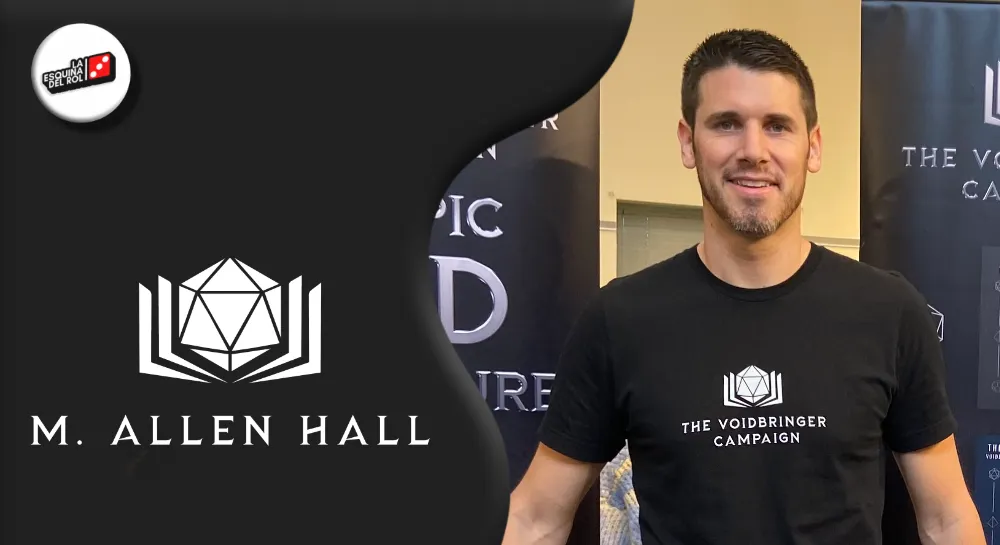
M. Allen Hall is writing tabletop role-playing games, supplements, and adjacent fiction. You can learn more about him at mallenhall.com.
Mario | La Esquina del Rol: So, M. Allen Hall, welcome to La Esquina del Rol. First of all I want to thank you for the time you are going to dedicate to this interview and, on the other hand, congratulate you for the success that In Ruins is turning out to be. I'm thrilled to see that people I've been following for a while are having a very good reception in the community with their projects. And in your case is no exception. Your previous projects and collaborations have been great.
But, as always, to start this interview. I would like you to introduce yourself to the community so they know who you are and what you do in the world of tabletop role-playing games.
M. Allen Hall: Hello, Mario! Thank you for inviting me. I have been reading your interviews for quite a while; I always enjoy the insights you elicit from other designers.
I am M. Allen Hall (or just Allen), and I have been writing since 2020 — one of many who was given the gift of "finally having enough time to write" in that year. I started out by writing a series of fantasy novels based in a game of Dungeons & Dragons. In my efforts to market those works, I managed to discover the world of indie RPGs through TTRPG Twitter in 2021 (may it rest in peace).
From there I started writing adventures and then games of my own, which turned out to be much more fun than writing novels, so I've kept that up since then.
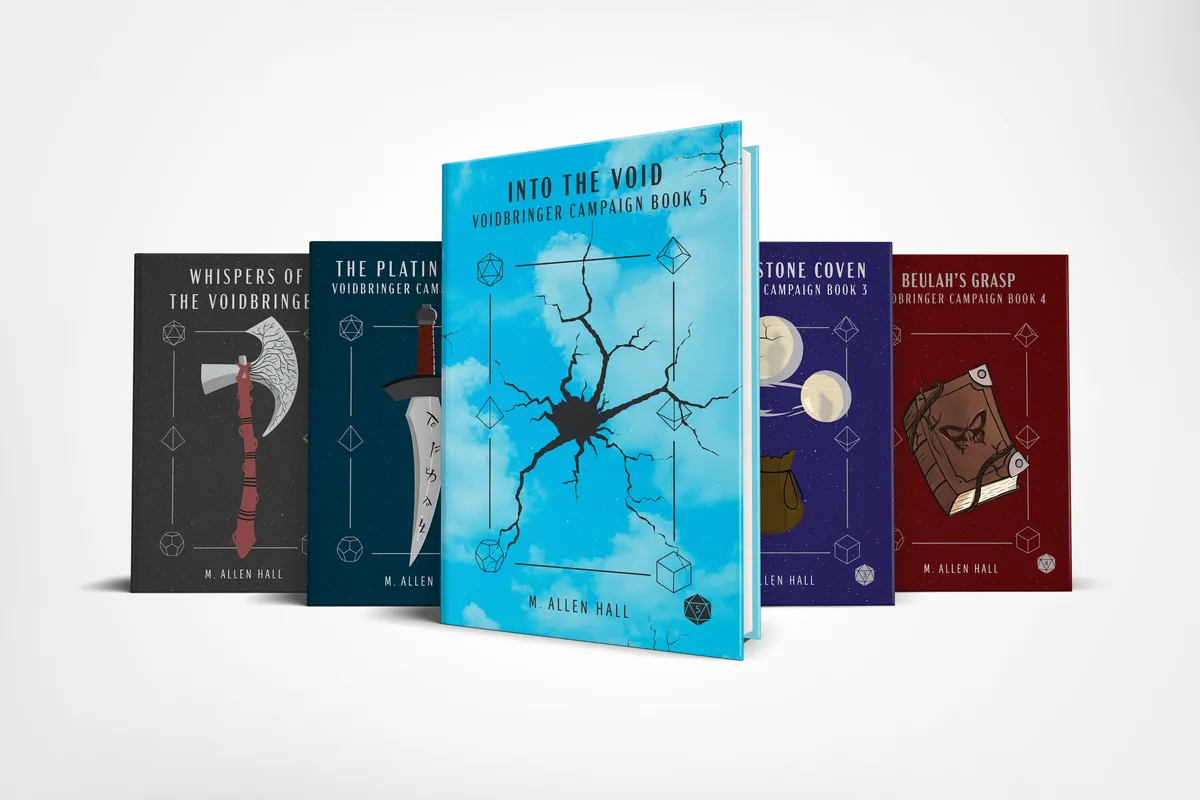
Mario: Wow! I didn't know you had written some fantasy novels before, and that led to your discovery of the scene. I've been following you since I joined Iko's Discord. You've written for several of my favorite games that I've translated or I am about to translate, and I really like what you do. I sincerely admire your work. You've even written solo games, which I'd love to discuss further later on because I'm an enthusiast of them.
But first, I'd like to know your thoughts on our current role-playing game scene. What is your perspective on these scenes where we all interact, quoting Iko a bit, and where do you envision the future of the hobby given the conditions we're currently facing?
M. Allen Hall: Oh boy, hitting the heavy questions early! When I first got into the indie TTRPG business, the scene felt very much like a scene. Things happened, and the scene changed. I think most interactions are happening on Discord now, which is a shame, because the inherent siloing that occurs on that platform turns the "scene" into dozens or hundreds of little scenes.
Where will it go from here? Of course, I don't know, but the way I am approaching it is as follows:
- Stay involved in a couple of Discord servers where there are designers that I respect and can learn from.
- Maintain my own audience using my newsletter.
- Utilize the visibility of crowdfunding platforms to further my reach with TTRPG enthusiasts.
- Expand my access to customers that are less invested in the hobby by partnering with games distributors.
There is no longer one place that I can go to access both other game designers and potential customers, so I need to do the work to keep both of those groups accessible.
Mario: Hahaha! sorry for the question, but it's something that really concerns me. I see many people migrating to Discord, and although I use it, but I'm not entirely convinced. I think it's a good app for chatting or being in small groups, but I don't get the same feeling in larger groups, where discussions start to resemble a real-world coffee shop—everyone talking, and almost no one listening to each other.
So, I agree with you; it really has evolved into lots of smaller communities. Many of them are great, but I feel like they still don't quite connect fully for me. I often feel like I'm missing something. I follow the same strategies you propose, but at times, the feedback doesn't feel as valuable as it used to be. I still see several accessibility challenges looming on the horizon.
Back to you —it's amazing how many resources we can find on your itch page, whether games, adventures, or even solo tools to play with.
I'd love to know more about your creative process. How do you approach the design of these resources for role-playing games? What's your process?
M. Allen Hall: My process, if you want to call it that, goes thusly: I have an idea, and I make a thing. The ideas that I have come from all over, from music, from movies, from conversations with designers, from conversations with people that don't know what TTRPGs are. If I could say that I am good at one thing, it would be finishing projects. That's why I love game jams. Someone hands me an idea and a deadline. I'm all over that. So, when you look at my itch page, you are seeing the result of that cycle happening a couple dozen times. Maybe it's my Pirate Borg supplements, or my One Page RPGs, or my ECO MOFOS!! module, or my modules for Liminal Horror or The Lost Bay. The majority of those projects came out of game jams.

Mario: If I had to ask in retrospect with everything you've written, where does Allen Hall feel more comfortable, writing adventures, designing a game or creating tools like oracles, generators and things like that? I mean, I know it's like choosing between your kids hahaha! but what do you feel more passionate about or challenged by right now as a writer and why?
M. Allen Hall: That's a tough one, since what I choose to create is very much impacted by my perception of what people are interested in buying. I very much enjoy writing adventures. I like creating weird little situations to see what people do to get their characters into and out of them. It is so satisfying to hear stories from other people that have run my adventures and hearing how their players solved some problem or other.
That being said, it's hard to sell adventures. Most of the games that I want to write for have fairly small audiences. It's much easier to sell a book that is completely playable by itself. So, that's what I've been focusing on with my recent releases. Even my upcoming Liminal Horror adventure collection will have a rules summary good enough that I can say to someone, "This box has everything you need to play the game."
Mario: In the Spanish-speaking world very few adventures are written in Spanish. And even when games are translated, very few adventures are translated to play those games. I think more adventures are needed, both in English and Spanish hahaha. But what you mention I think is important. I even just read a trophy dark incursion that Josh Domenski wrote and I did see that it includes that little rules summary so you can play the adventure without needing to have the whole rule book, of course if you have the book you have all the rules and options but it works. I hadn't thought about it, but now that you say it and I remember this particular adventure it makes all the sense in the world.
Now I would like to know how you got started in solo role-playing games and decided to start writing them. How has this experience been for you?
M. Allen Hall: Well, I only started playing TTRPGs at all in 2019 when some people from work started a game of D&D 5e. 2020 killed that game, but by then I was hooked. It wasn't until I found the indie TTRPG community in 2021 that I learned about solo role-playing. My first foray into writing a standalone game was by using the Wretched & Alone SRD to make a journaling game. The reception that game had really got me into the solo role-playing niche of the hobby. After playing — and making — some more journaling games, I got my hands on Thousand Empty Light, which opened up my mind to the idea of playing a multiplayer TTRPG as a solo game. From that inspiration I wrote my solo toolset for Pirate Borg (Captain & Crew), which is now my most downloaded project on itch.
Mario: Congratulations on the success of captain & crew! It's very interesting your way in to solo games and now that I think about it the first thing I designed was a journaling game. I am mean, as Sam Leigh told me, it's a good entry for new designer games, just like me.
So, I would like you to tell us a little bit about your last games. I'm particularly interested in Endling. Tell us a little bit about it, where did the idea come from and how was the experience of designing this game that finally got funded last year?
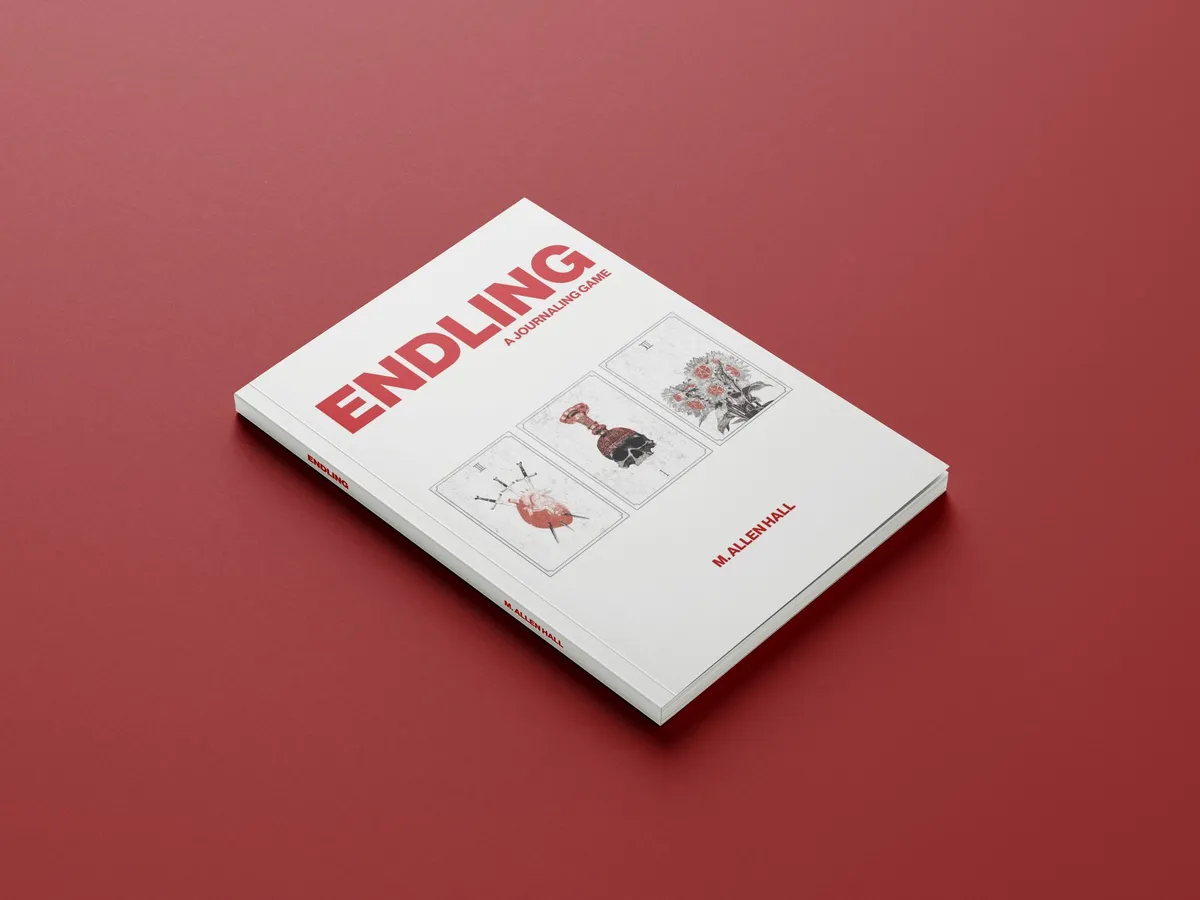
M. Allen Hall: It's funny you should mention Sam, since their game Anamnesis inspired one of the core mechanisms of Endling. From the beginning though, Endling was a game more about a vibe than any particular mechanism. It started as a conversation with a couple of other designers about the idea of an endling (the last member of a species), and how a journaling game about being an endling (the last human) could be cool. I sat on that idea for a year before making a 1-page RPG Endling that I never released. That game was just the hexflower and resource management mechanisms that you see in the final version of Endling. I never released that game because, well, without the journaling, it was kind of boring. Just a bunch of dice rolling.
Then, I happened to take another look at Anamnesis, and the rest of the game clicked into place. I would make a tarot-based journaling game. But, I would build it around the resource management game I had already created. I like games with a little bit of player agency, and I think I was able to keep just enough to make Endling interesting: you have to decide every round if you Move or Stay. With that little twist added to the journaling, you add the stress of possibly failing to reach your goal, which, I think, enhances the experience of responding to the prompts.
Mario: Wow!The concept of 'endling' is quite cool. I really like that little twist you add to game design. Those are the gems that take the experience to the next level. I think this makes journaling very interesting to me, in terms of design and gameplay. I like it when table-top interaction with objects like tarot or even Jenga is incorporated, along with other elements drawn from board games. You know, it’s very interesting.
On another note, something I absolutely impress about you is your creativity. It’s clear that you’re very talented. I have to be honest, and this is something ChrisAir told me —you have incredible skill when bouncing from one genre to another, and you doing it really well. Right now, you’ve funded In Ruins,' and you have a project involving liminal horror (which I’m dying to learn more about). I’d love for you to tell us a bit about these projects and, honestly, how you manage not to lose your mind? Haha!
M. Allen Hall: Bouncing between genres is definitely one of the things I love about TTRPGs. There are so many different kinds of games to write, I try hard not to get bored or stale. I also like when every new project pushes me in some way to learn a new skill or add a new mechanism to a game.
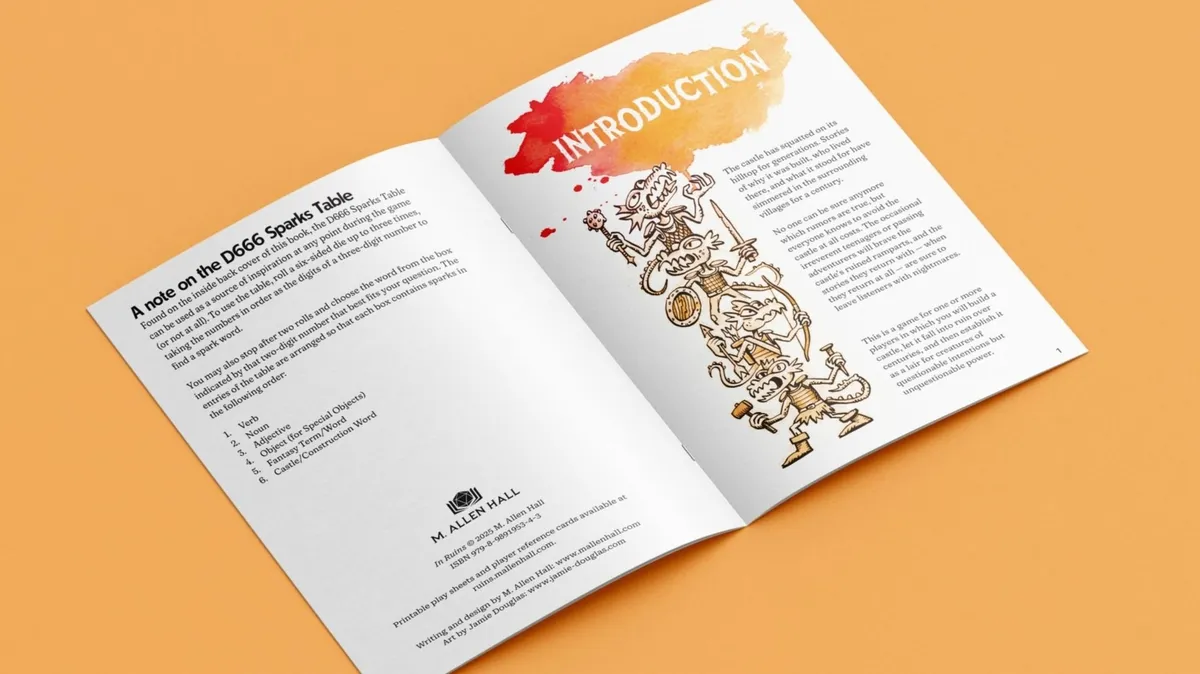
'In Ruins' started as a storygame only, collaboratively building a dungeon that you could then explore using whatever TTRPG you play. During play testing, it evolved to include some competition, which makes it stand on its own better. This was my experiment with storygames as well as asymmetric roleplaying, since the players each get a different special ability.
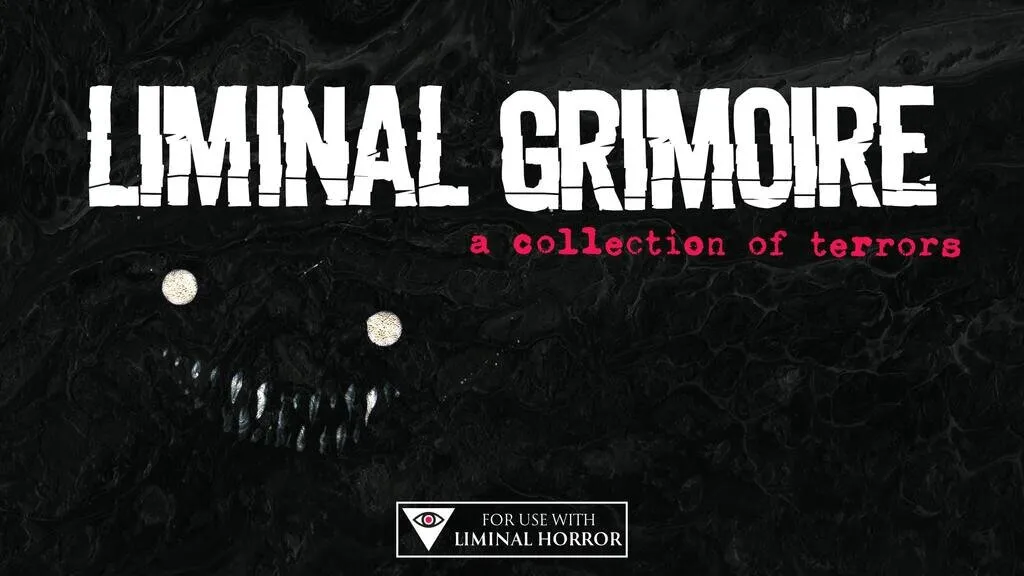
My Liminal Horror project is called Liminal Grimoire. This is a collection of pamphlet adventures. I love writing pamphlets, but selling them can be difficult, since people are used to brochures being free. One solution to that is to bundle them into a set. Liminal Grimoire is a bundle of pamphlets (currently containing 5 adventures, a solo toolset, and character sheets). This will be my first time producing something that comes in an actual box, and I'm excited to see what that looks like in the end.
Mario: It’s truly amazing what awaits us with these two projects. I hope they both continue to add to the growing list of things you share with the community. So, Allen, where is your creativity taking you at the moment? Is there any sneak peek you'd like to share about where your pen is headed? No pressure, of course —haha!
M. Allen Hall: Well, what I'm working mostly on currently, other than the finishing touches on the Liminal Grimoire supplements, is actually setting material for a game called Midnight Muscadines, which is being published by Pandion Games. I've already written two starter adventures for that system, and now I am writing a portion of the setting guide. It's a strange world with a shattered sun and two main societies: those that live in the light of the remaining sunshards that have been turned into massive beacons to light a land called Nimm, and those that live in the darkness of the rest of the world, the Wildernight.
For my own games, I think I am going to turn my attention to Auctoratus next. This is a game that I published for the 1-Page RPG Jam last summer as a free solo or 2-player mech-focused skirmish game. It utilized a mancala/rondel mechanism that allowed for modular mech construction and zero-luck combat. The game got a great response, and I'd like to expand it into a full game with a series of scenarios that could be played as a campaign.
Mario: I can't believe it. Andy is putting together a great team. He's one of the designers I most admire for his versatility when it comes to creating games. I think it's great news that he's included you and I'll be very interested to see what comes out of this collaboration.
As for your games, I'll be looking forward to seeing how the project evolves and I hope to read about it later to share it with our readers!
So, Allen it has really been a pleasure to get to know you more as a writer and designer. I really admire your work and the versatility you have for writing. I think the Spanish-speaking community will find you someone worth following.
But, tell me, where can they keep up to date with what you are doing or what you are going to publish next, or even for our English speaking community that will interested in approaching you to invite you to collaborate, where can they find you?
M. Allen Hall: I have been very impressed with Andy's games as well, and I was very excited when he invited me to be part of the team for this one.
Thank you so much for having me! As for where people can find me, I post a newsletter one or two times a month here: inkanddice.substack.com. And if anyone wants to get in touch, there is a Contact button on my website www.mallenhall.com.
Mario | La Esquina del Rol: Thank you Allen, it was wonderful to learn more about your creative process and your work!
M. Allen Hall: Of course! Thanks for inviting me.
Allen's next project will be released on April 15.
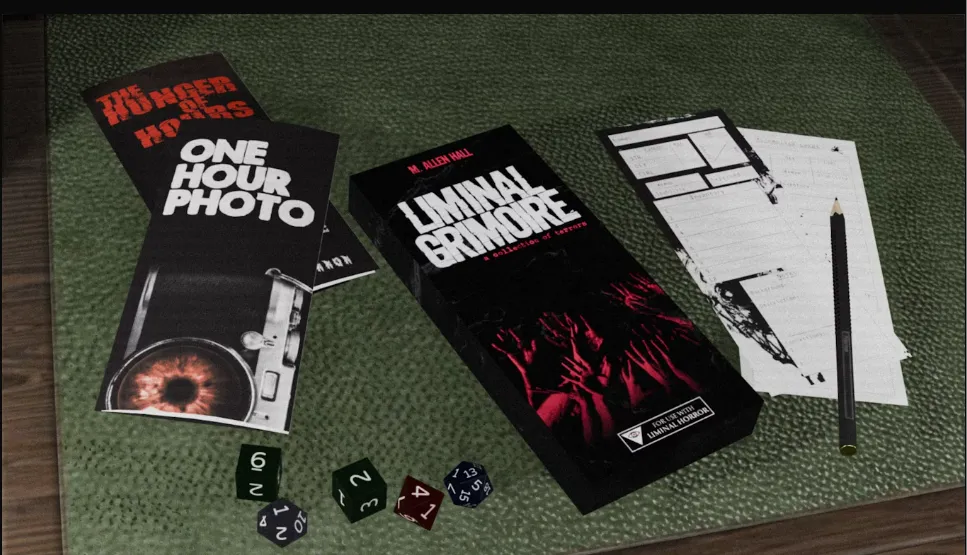
Liminal Grimoire is a collection of pamphlet supplements by M. Allen Hall for the modern horror role-playing game Liminal Horror.
- Get lost in the backrooms in The Hunger of Hours.
- Find your way out of the Harvest Fest corn maze while being hunted by The Reaper.
- Escape Moe's House of Meat, or end up on the menu.
- Try to stop the Pelagic Priory from summoning the Vast Beneath in Brine.
- Get out of the basement of One Hour Photo before the Attendant finds you.
- Start your solo game of Liminal Horror with the tools to play Alone in the Dark.