An Interview with René-Pier Deshaies

René-Pier Deshaies is a CRIT-nominated and Canadian TTRPG Designer. He made Stoneburner, Breathless, Firelights, etc. You can learn more about him at farirpgs.com.
Mario | La Esquina del Rol: Rene-Pier Deshaies, Welcome to La Esquina del Rol! I'm very excited to have you here. For me you are in my top 5 of current game designers that I admire the most for your versatility in game design. You are a machine for generating interesting game concepts, and sharing SRDs to push game design forward among the community, not only in English but also in Spanish. I appreciate since I met you your interest in betting on accessibility and giving us the opportunity to read your games in our own Spanish language. How is everything?
René-Pier Deshaies | Fari RPGs: Hey!!! First off, thank you so much for having me! I’ve always loved our interactions and I’m very excited for this conversation.
Also, those are some beautiful compliments, I’m honored truly. Thank you so much.
Apart from that, things are very good. Busy, for sure. But very good! Hope you’re doing great as well.
Mario: I am doing very well, thank you very much! You are always very kind!!
My first contact with you was a long time ago and it was to ask you if I could translate Charge SRD. You were very kind and I remember you were very excited. Since then I have seen you grow a lot as a designer and as a member of the international RPG community. But, I'd like to start this interview by asking you to introduce yourself. Especially for those people who read us and maybe know your games but don't know who you are.
So, Who is Rene-Pier Deshaies and how did you get started in tabletop RPGs?
René-Pier Deshaies: Oh yeah, for sure. So, my name is René-Pier Deshaies-Gélinas, but everyone calls me RP. I'm based in Québec, Canada, and run an independent TTRPG design studio called Fari RPGs since 2021.
I've designed and published over 15 games, and around 5 system reference document that people have used to themselves create and publish over 350 different games in English, French, Spanish, Japanese and more.
I first got known for developing a free and open-source virtual tabletop called Fari App, then for being the person who published the Fari Community website, which is a website that people can use to read over 50 different system reference documents and other TTRPG resources. A bit after that, I published my first game, a free and generic role-playing game based on ideas from Fate and Blades in the Dark.
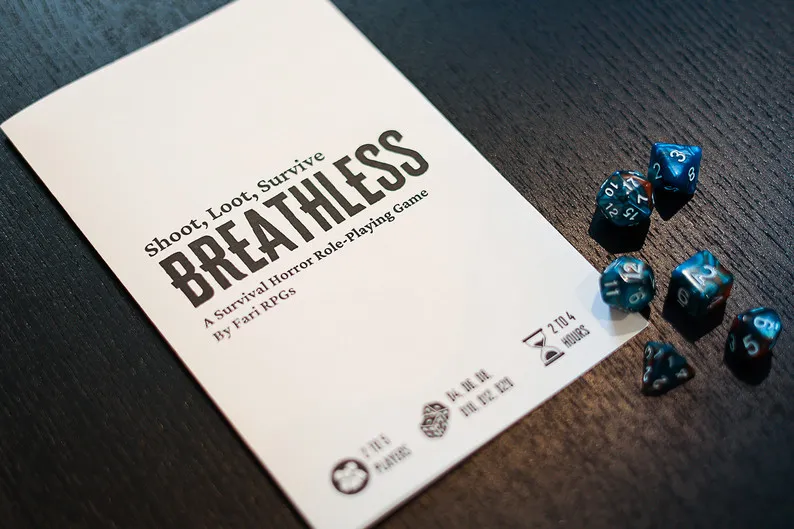
Nowadays, most people know me from being the person behind Breathless, Firelights, and Stoneburner, among others.
Mario: When I interviewed Andy from Pandion Games, I asked him to formulate a question for you. I'd like to take this question and ask it to you: "What is your process for coming up with interesting worlds or concepts for your games?".
René-Pier Deshaies: Oh I love this. Coming up with a good setting is so much work but once you have a good one, you gotta stick to it. One way I usually start is by consuming lots of medias. Books, movies, tv series, video games. From there, if there's a world that's inspiring to me, I start thinking about how I could make it my own. A good way to do that is to look into merging it with another world. For example, you take a video game you love, and merge its setting with a movie that inspired you recently. From there, you have a pretty nice foundation on which you can build upon. Then you start removing things that don't feel unique enough, add things to make it more interesting. Lastly, I start thinking about questions that needs to be answered. If a world is introduced to a table, players will have questions and thinking about those questions while desining it is super important. E.g. how to people travel? What do they eat? What is the threats or dangers in their lives? etc.
Mario: What I love is that you never stop creating, and if you're not making something of your own, you're helping Andy with ideas to develop his game. Your ability to be so creative and support others is really amazing.
Well, let's just say you've already got the setting pretty clear and quite original, as usual. In terms of game design, what do you consider to be the philosophy and design principles that frame the way you design and write your role-playing games?
René-Pier Deshaies: That's very kind of you. I do think this community as a whole truly revolves around... well, "community" in the truest sense of the word. A tide that rises all boats, and people not acting according to this aren't here for the right reasons. Bouncing ideas with fellow designers, helping people get started with resources and tips, boosting the signal of projects you find fun and fascinating—this is what makes this hobby enjoyable!
As for philosophies and design principles, I always try to make my games solo-friendly, accessible, and action-focused. By solo-friendly, I don't necessarily mean completely solo experiences, since I usually play with a group of players. But I love solo gaming, and designing mechanics that work well both in groups and solo is the best of all worlds.
Accessibility is another key factor. I believe a game should be easy to read and understand, both in terms of format and layout, and in making the text "simple" when explaining game mechanics. Game mechanics are often the hardest part to grasp, and I've read too many games that try to be fancy in their writing or don't explain things in the right order, making the rules harder to understand. This is even more challenging for people who don't speak English as a first language, like myself. When writing lore, interesting and sophisticated prose can be wonderful, but in my opinion, game mechanic chapters should be as clear as a step-by-step tutorial. As a software engineer, I often write cookbooks, install guides, and technical documents. Being able to convey a clear message in a document is super important.
Lastly, I love action or adventure movies and video games. When I play TTRPGs with my friends, I thrive on action-packed and dramatic scenes. This is something I always try to incorporate into my world-building and mechanics!
Mario: You mention several things that interest me. First of all, I would like to address the topic of solo roleplaying games, or as you say, solo-friendly games. When did you start making solo-friendly games, and what is the reason why your design philosophy includes this element as fundamental for you?
René-Pier Deshaies: The first ever solo game I designed is called Nomadic, and it's a 'Breathless' game of solo exploration inspired by No Man's Sky. I had never designed a solo game before, and I wanted to see how far I could push the Breathless engine. I started reading more and more about solo game design, and Ironsworn by Shawn Tomkin was such a huge inspiration for how I design solo games or solo-friendly games even to this day. One of the cool things about Nomadic is that even from the start, I knew I didn't want to make something that was entirely solo since Nomadic includes mechanics that let you "beam out" messages to other players out there, allowing you to play the game with other players but asynchronously.
This is where I started thinking about solo-friendly games. Kind of like how a website can work for both mobile and desktop, having gameplay that is "responsive" to its players is a concept that I find very fascinating. Because, again, it makes the game more accessible!
Your players can't make it this week? No worries, play a session by yourself. Players are here, but the GM feels a bit under the weather? Then share the GM responsibilities across the table. By making a game that has player-facing mechanics, oracles, and a setting that is vastly understood at the table, you can make it work.
Mario: Nice! Nomadic is an interesting game, by the way already translated into Spanish thanks to Antonio del Refugio de Ryhope.
Here on the blog we try to go a bit deeper into the approach of the designers when developing their own games. You already told us how you come up with an idea or concept for a setting, maybe that's the first big step for you. Now we would like to know what the next steps are. Both in terms of mechanics and the art direction of the game itself.
So, How do you approach your creative process when you design a new game?
René-Pier Deshaies: Yeah, the folks at El Refugio de Ryhope are fantastic!
As for mechanics, I always try to design games that I call "rules-bright." This means they are rules that work with the setting. It reinforces the themes of the game. For example, in Breathless, I wanted to make a game about survival, so the mechanics of skills always stepping down one die size every time you use them made sense! For my Firelights, I wanted to make a TTRPG that felt like a Metroidvania video game, so I used a deck of playing cards as a way to build an actual physical map that looks like one pulled right out of Hollow Knight or Ori and the Blind Forest.
I often try to cover as many gaming aspects as possible when designing rules, but I often find myself removing as many of them as I can towards the end of the development cycle. I don't want to clutter the game with useless rules. If a game reinforces the setting, it stays in. Otherwise, it's out. I think there's no point in having them.
There are lots of amazing systems out there I could use for my games, but I find myself often designing my own systems using the amazing work of other designers as inspiration. This is a lot of work, but it often pays off because when you start from the ground up, you know that everything you design was done just for this game, its setting, and its themes.
I'm a software engineer during the day, so I often write automated programs to test my mechanics or use them to run solo playthrough campaigns. This helps me make sure my mechanics and systems are as solid as possible. That, and the amazing playtesters of my Discord server!
For the art direction, I'm mostly looking at other games or art books for inspiration. Not necessarily books within the same genre, but books that I find beautiful. Then I use this and throw spaghetti at my screen until something sticks! Then I send early layout concepts to my main illustrator, Galen Pejeau, which he uses as inspiration for his own art!
Working with an illustrator is truly amazing because you get to bounce back ideas and early concepts like a game of ping pong, where the game just gets better and better in between each rebound!
Mario: Impressive. I really like your use of the term ‘rules-bright’. One thing I notice about your work is just that, how the rules add a lot to the setting and experience of the game.
I don't know if that's a tough question. But what are the three mechanics you've designed so far that you would choose as the ones you're most proud of, and why would you choose them?
René-Pier Deshaies: I feel like this is something that's crucial for making a game stand out. Otherwise you could easily end up with another basic d20 VS modifier game that doesn't add anything new to the table.
As for three mechanics that I've designed, that's a tough one! I'd say...
1. Breathless' gameplay loop: In Breathless, you have skills that are tied to a die rating (d4 - d12), and when you use them, they step down by one die size until they reach a d4. Many people think that this is what makes a Breathless game a... well, "Breathless game." But I'd argue that this is only half of the equation. Breathless wasn't the first game to use dice that step down and up! I think where Breathless shines is through its gameplay loop. Once all your skills are set to a d4, what do you do? Well, you have to "catch your breath"! This will reset all your dice to their original ratings, but it also prompts the GM to add a new complication to the scene. This is where the game best reinforces classic survival horror stories, I think. Yes, the characters were able to get a breather, but there's always something more dangerous creeping around every corner.
2. Firelights' tied actions: Firelights is a solo exploration game. Your character has a couple of approaches (stats) that they use to interact with the fiction using a set of "actions." They use those to explore the world and create an actual physical Metroidvania-style map using a set of playing cards. But I think one of the coolest aspects of the game is how actions automatically prompt other actions! For example, let's say you make a roll to fight a big boss using the "fight a curse" action and fail that roll; that roll automatically triggers the "evade danger" action. Or if you roll to "search for treasures" and fail, it may trigger that a "curse is onto you." The fact that certain action results automatically lead to other actions, I think, is one of the most interesting aspects of Firelights.
3. Songs and Sagas' cards: Songs and Sagas is the latest game I released, which is an OSR-inspired game with a twist! In the game, you have a hex map, and each region is associated with a risk rating. That rating, which ranges from 1 to 3, determines the number of cards that you reveal when you make a roll. When you roll, you make a classic d20 + modifier against a target number. But for every black card that you reveal, the GM increases the target number by 2. So the more dangerous the region, the higher the risk rating, and the more chaotic the rolls can be. But where it gets really fun is that when you succeed on a roll, you get to add one of the revealed cards to your hand but MUST pick red cards over black cards. Players can then "burn" those cards to get various bonuses. But if players start hoarding this meta currency, the deck of cards starts getting more and more filled with black cards, which leads to more and more dangerous rolls. So this all prompts players to burn their cards as soon as possible to prevent the deck from always acting against them.
I'd say those are among the top things I designed that I'm really proud of. This last one in particular, I had been playing with this idea for a long time, but it took me a lot of work to make it just right.
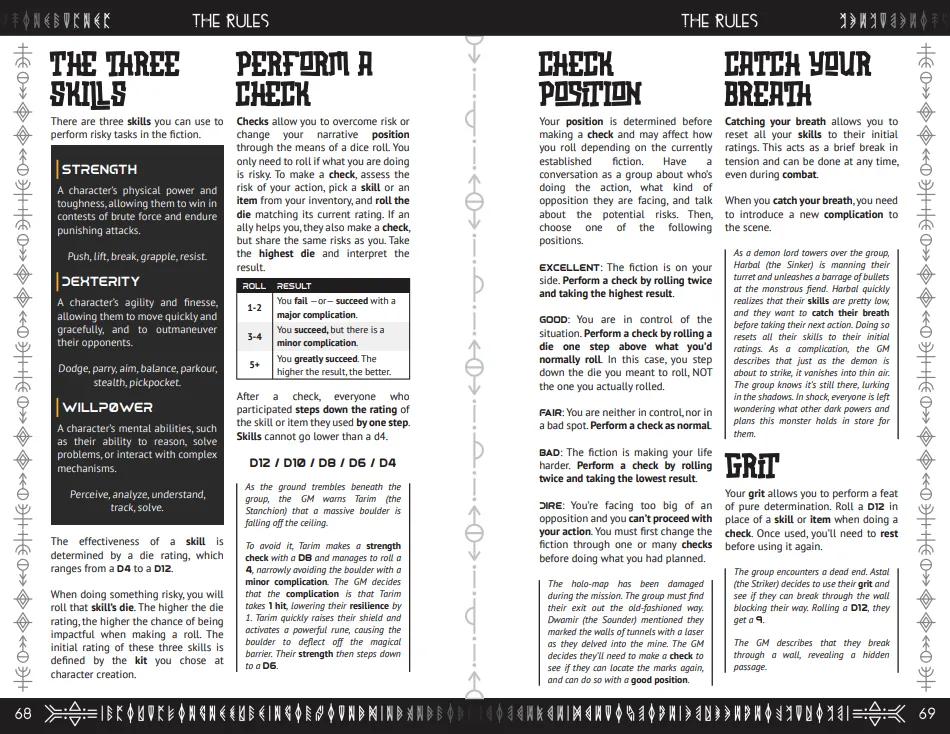
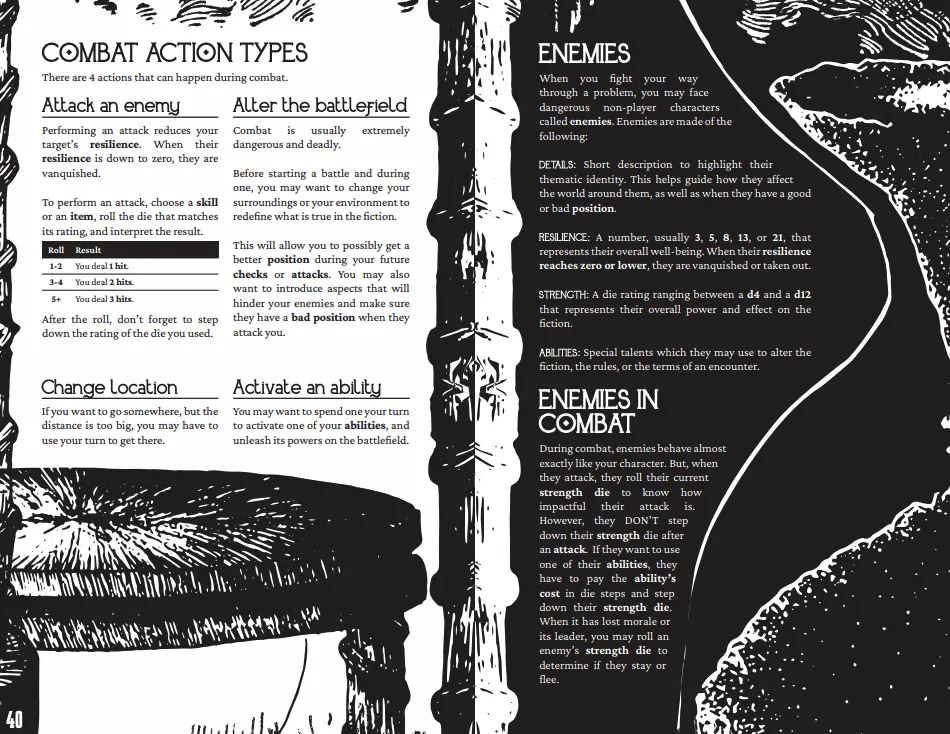
Mario: One thing I really like about the layout design you do in your games is that it allows us to read smoothly between the pages of your games. I've already seen several videos about how you use affinity and I really appreciate them because I've learned a lot. I'm curious to know: which are the pages of the games you've designed that you're most proud of (in terms of layout design) and why?
René-Pier Deshaies: Thank you! I truly try to make layouts that look pretty and nice but are still accessible and easy to read. A middle ground between a tech document and Mörk Borg, I guess, haha.
In terms of my favorite pages....
This one from Stoneburner, while simple, I think truly communicates the kind of style I do. Thematic yet accessible and easy to read, with touches here and there that attract the reader's attention. It was also one of the first bits I did for the game, so it holds a special place in my heart.
This spread from Tales of the Burned Stones took a little more effort, but is such an eye-catcher! I think one key to creating layouts is to keep each spread fresh and different from the last. That way, reading the game is more fun and enjoyable.
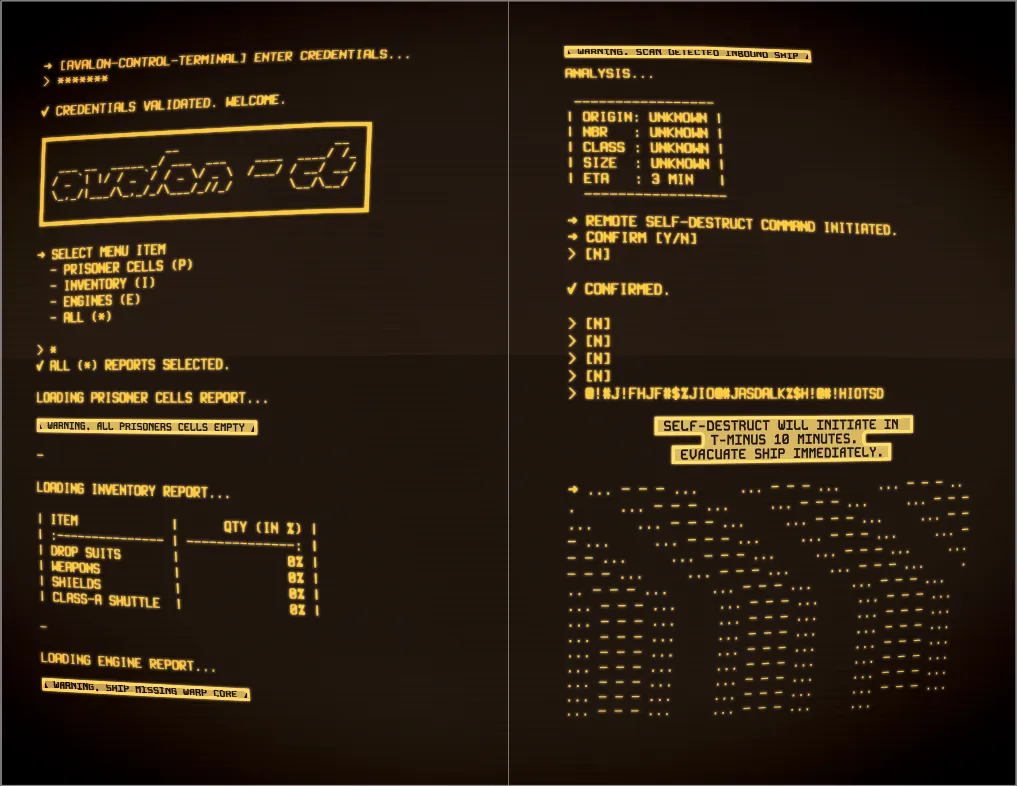
And this one, from an upcoming project I'm working on with Galen Pejeau. I really wanted to imitate the vibe, glow, form, and scan lines of an old computer terminal, and I think I'm pretty much there.
Mario: Something I love about the way you are is that you are very creative and restless, always thinking about creating. What are you working on to surprise us in 2025?
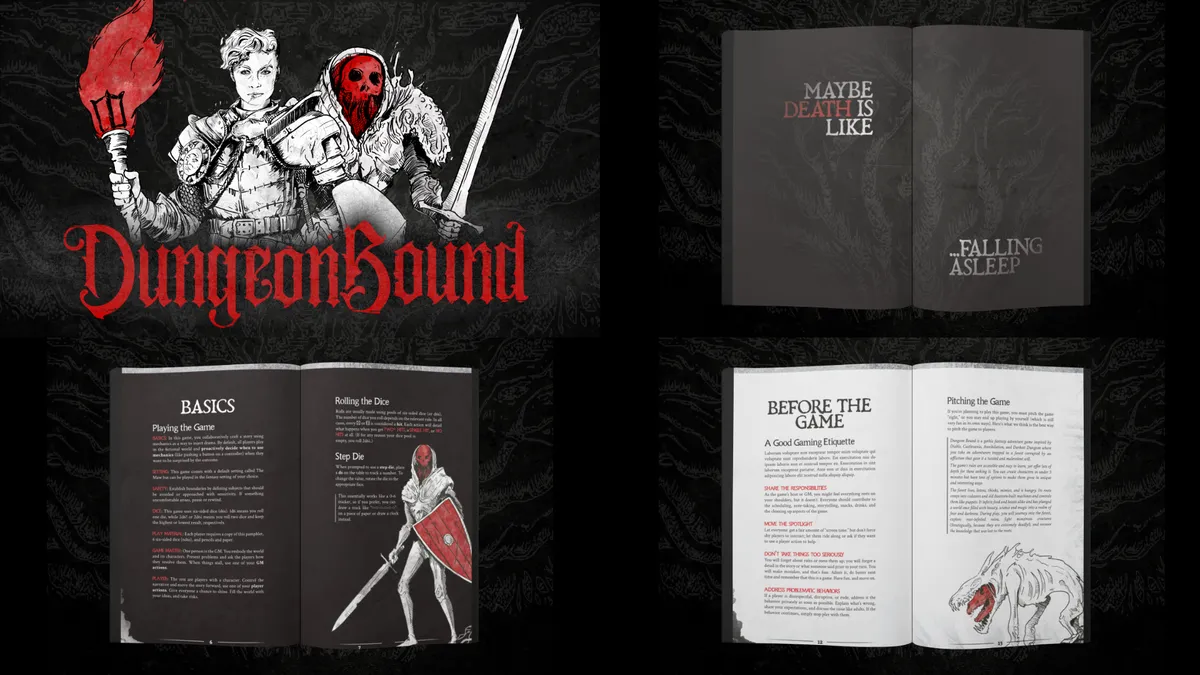
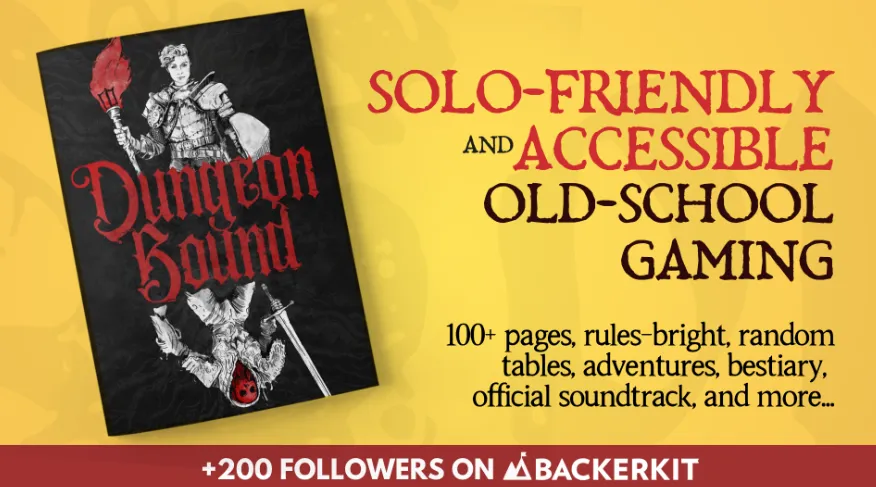
René-Pier Deshaies: So, for 2025, my next big project will be a gothic horror RPG inspired by Castlevania, Annihilation, and Diablo called: Dungeon Bound.
It is an old-school style, solo-friendly, and action-driven tabletop role-playing game where you play as brave souls trying to find their way in a world grown dark under the shadow of an otherworldly woods bound to the spirit world.
Essentially, there's this forest that has gotten a will of its own through the power of some corrupted spirits. Now the forest is like a tumor that just won't stop eating, consuming cities, castles, dungeons, and people, returning the taken as wooden puppets against the few remaining bastions of warmth and light.
I'm working with Galen as the game's illustrator, but also with six other writers to create adventures and a bestiary, and also a dice maker to create some truly stunning, thematic dice for the game.
I hope to release the crowdfunding campaign before the summer of 2025, but we will see. The life with two very young kids is unpredictable, so I'm taking each day on its own.
Mario: Wow! I really admire how each game you have designed since I’ve known you has led to increasingly interesting settings. What challenges have you faced in developing the setting and concept of the game?
René-Pier Deshaies: There are two main things that I've been struggling with for this game. The first being how to make yet another fantasy dungeon-oriented game that's unique and exciting world-building-wise. Making a cool pitch for a setting actually consumes a lot of my time, so I truly appreciate the compliment you just made! But yeah, in this case, trying to come up with a setting that is not overwhelming with history and lore but is still filled with enough interesting factions, problems, and goals for the characters is a fun but time-consuming challenge.
The other thing that's been challenging is the refinement of the system. I've never made a system that has taken me that much time to refine, but that's because I'm very close to something that's truly elegantly simple but still offers lots of versatility. The last part that needs a tiny bit more refinement is the combat system, but I'm getting there! What makes this aspect easier is how many great games there are out there which can be used as inspiration for what I'm trying to building. Literally sitting on the shoulders of amazing creators.
Mario: Oh, I think what you just said has increased my hype about the game!!!! I understand you're talking about refining the system, so does the game have its own new system? And if so, what can you tell us about it in broad terms?
René-Pier Deshaies: Sure! So yeah. Dungeon Bound will have its own system, which I'm calling the Boundless System. This is a system I've been working on and playtesting for a long time, around the same time I was working on Songs and Sagas in December 2023, actually. It has a very elegant core engine that is fast to use and easy to remember but flexible enough to add more subsystems to create rules that are very thematic.
It's a dice pool-based system that only uses d6s, where every 5 or 6 that you roll is considered a "Hit." The game tells you what happens if you get two or more Hits, a single Hit, or no Hit at all. But the way those pools are built differs from one rule to another. Want to make a check? You build your pool with your Attribute ratings, Aspects, Items, etc. Want to avoid danger? In this case, the pool is built off the number of Stress your character has, and the more Hits you get, the worse the outcome. Want to avoid dying with a death save? You build the pool off the number of Wounds your character has, where the more Hits you get, the closer you get to actually perishing.
What's super elegant about this is that the "Hits" created from the rolls can also be used to calculate the impact of a roll. Want to use a "clock" for some sort of long-term effort or project and want to know how much a Check will move that clock forward? Easy, count the number of "Hits" from the roll.
So yeah, the system uses this core mechanic and plays with it in a ton of very fun circumstances.
Also, combat-wise, I'm playing around with the idea of Metroidvania-style boss fights where bosses have multiple phases they go through during a fight, and it's been proving to be a fantastic way to make combat more engaging and designing monster stat blocks way more entertaining for me!
After the Breathless SRD After the Firelights SRD After the Songs and Sagas SRD
Prepare yourself for my next rule system.
Play until you break. Then stand back up and keep playing.
A "spiral of resilience".
— René-Pier Deshaies (@rpdeshaies.farirpgs.com) February 12, 2025 at 4:00 PM
[image or embed]
I had the opportunity to read a draft of the rules in advance. My thoughts: A system with super elegant rolls, René-Pier has done it again, always taking a step forward in terms of design and setting. He's a genius.
And that's all for today, folks! I hope you enjoyed this interview. Until next time!